Quantum Condensed Matter Physics
笹本 大樹
Daiki Sasamoto
Daiki Sasamoto
東北大学大学院 理学研究科 物理学専攻
固体統計物理学講座(物性理論研究室)那須グループ 博士後期課程3年。
物性物理学の理論研究を行っています。
Ph.D. student (3rd year), Nasu Group, Condensed Matter Theory,
Department of Physics, Graduate School of Science, Tohoku University.
I work on theoretical condensed matter physics.
関連リンク:Google Scholar / researchmap / ORCID / arXiv / ResearchGate 所属リンク:東北大学 大学院理学研究科・理学部 / 物理学専攻・物理学科 / 固体統計物理学講座(物性理論研究室) / 那須グループ
Links: Google Scholar / researchmap / ORCID / arXiv / ResearchGate Affiliations: Graduate School of Science / Department of Physics / Condensed Matter Theory Group / Nasu Group

お知らせNews
- 2026.09.16 日本物理学会 第81回年次大会(東京大学)で口頭発表を行いました。Gave an oral presentation at the JPS 81st Annual Meeting, University of Tokyo.
- 2026.09.08 プレプリント "Schwinger boson perturbation theory for spin-\(S\) Kitaev-Heisenberg magnets: phase diagram and dynamical response near Kitaev spin liquids" を arXiv:2609.08548 として公開しました。Posted a preprint "Schwinger boson perturbation theory for spin-\(S\) Kitaev-Heisenberg magnets: phase diagram and dynamical response near Kitaev spin liquids" as arXiv:2609.08548.
- 2026.08.30 プレプリント "Thermal Hall Signatures of Distinct Schwinger-Boson Flux Sectors on the Honeycomb Lattice" を arXiv:2608.29792 として公開しました。Posted a preprint "Thermal Hall Signatures of Distinct Schwinger-Boson Flux Sectors on the Honeycomb Lattice" as arXiv:2608.29792.
- 2026.08.28 量子物性若手交流研究会(滋賀県近江八幡市)で口頭発表を行いました。Gave an oral presentation at the young researchers' workshop on quantum matter, Omihachiman.
- 2026.08.19 プレプリント "Chiral bosonic mean-field Ansatz and spin dynamics in spin-1 Kitaev magnets" を arXiv:2608.19178 として公開しました。Posted a preprint "Chiral bosonic mean-field Ansatz and spin dynamics in spin-1 Kitaev magnets" as arXiv:2608.19178.
- 2026.08.05 論文 "Dynamical spin correlations in kagome antiferromagnets: Comparison of the Abrikosov fermion and Schwinger boson approaches beyond mean field" が Phys. Rev. B 114, 074405 (2026) として出版されました。Our paper "Dynamical spin correlations in kagome antiferromagnets: Comparison of the Abrikosov fermion and Schwinger boson approaches beyond mean field" has been published as Phys. Rev. B 114, 074405 (2026).
- 2026.08.04 論文 "Schwinger boson theory for \(S=1\) Kitaev quantum spin liquids" が Phys. Rev. Research 8, 033138 (2026) として出版されました。Our paper "Schwinger boson theory for \(S=1\) Kitaev quantum spin liquids" has been published as Phys. Rev. Research 8, 033138 (2026).
- 2026.06.19 物性理論合同セミナー(東北大学)で "Spin dynamics in kagome spin liquids" について発表しました。Gave a talk "Spin dynamics in kagome spin liquids" at the Condensed Matter Theory Joint Seminar, Tohoku University.
- 2026.06 ミュンヘン工科大学の Johannes Knolle 教授のグループを訪問しました。Visited the group of Prof. Johannes Knolle at TU Munich.
- 2026.04.17 ケルン大学の CMT Group Seminar で発表しました。Gave a talk at the CMT Group Seminar, University of Cologne.
- 2026.03.25 日本物理学会 2026年春季大会で口頭発表を2件行いました。Gave two oral presentations at the JPS 2026 Spring Meeting.
- 2026.03.23 プレプリント "Dynamical spin correlations in kagome antiferromagnets: comparison of Abrikosov fermion and Schwinger boson approaches beyond mean field" を arXiv:2603.21513 として公開しました。Posted a preprint "Dynamical spin correlations in kagome antiferromagnets: comparison of Abrikosov fermion and Schwinger boson approaches beyond mean field" as arXiv:2603.21513.
- 2025.12 ケルン大学 Simon Trebst 教授のグループで半年間の海外研修を開始しました(–2026.05)。Started a six-month research stay in the group of Prof. Simon Trebst, University of Cologne (–May 2026).
- 2025.10.20 国際ワークショップ TTQM2025(埼玉大学)でポスター発表を行いました。Presented a poster at TTQM2025, Saitama University.
- 2025.09.30 プレプリント "Schwinger boson theory for \(S=1\) Kitaev quantum spin liquids" を arXiv:2509.25761 として公開しました。Posted a preprint "Schwinger boson theory for \(S=1\) Kitaev quantum spin liquids" as arXiv:2509.25761.
- 2025.09.18 日本物理学会 第80回年次大会(広島大学)で口頭発表を行いました。Gave an oral presentation at the JPS 80th Annual Meeting, Hiroshima University.
- 2025.07.06 強相関電子系国際会議 SCES2025(カナダ・モントリオール)でポスター発表を行いました。Presented a poster at SCES 2025, Montreal, Canada.
- 2025.06.25 研究会「創発量子現象の凝縮系物理の新展開」(京都大学基礎物理学研究所)で口頭発表を行いました。Gave an oral presentation at the workshop on emergent quantum phenomena, YITP, Kyoto University.
- 2025.05.25 フラストレート磁性国際会議 HFM2025(カナダ・トロント)でポスター発表を行いました。Presented a poster at HFM2025, Toronto, Canada.
- 2025.05.22 学術変革領域研究(A)「キメラ準粒子」領域会議(東北大学)でポスター発表を行いました。Presented a poster at the Chimera Quasiparticles project meeting, Tohoku University.
- 2025.03.18 日本物理学会 2025年春季大会で口頭発表を行いました。Gave an oral presentation at the JPS 2025 Spring Meeting.
- 2025.03.10 ISSP Workshop「カゴメフラストレート磁性研究の進展」(東京大学物性研究所)でポスター発表を行いました。Presented a poster at the ISSP Workshop on kagome frustrated magnetism, University of Tokyo.
- 2024.11.20 国際シンポジウム The 8th Symposium for the Core Research Clusters for Materials Science and Spintronics をオーガナイズしました。Organized the international symposium The 8th Symposium for the Core Research Clusters for Materials Science and Spintronics.
- 2024.08.27 量子物性若手交流研究会(静岡県熱海市)で口頭発表を行いました。Gave an oral presentation at the young researchers' workshop on quantum matter, Atami.
- 2024.08.05 磁性国際会議 NFAM2024(北海道大学)でポスター発表を行いました。Presented a poster at NFAM2024, Hokkaido University.
- 2024.04 東北大学 那須グループの博士後期課程学生として研究を開始しました。GP-Spin プログラムにも所属しています。Started my Ph.D. in the Nasu Group, Tohoku University. Also joined the GP-Spin program.
自己紹介About
東北大学大学院 理学研究科 物理学専攻 固体統計物理学講座(物性理論研究室)
那須グループの博士後期課程3年です。
量子多体系のダイナミクスに興味を持って研究を行っています。
中でも強相関電子系に強い関心があり、分野全体を広く見渡せるよう日々勉強を続けています。
もっとも、博士課程での主な研究対象は、遍歴電子系というよりは量子スピン系(局在電子系)で、
とりわけ量子スピン液体状態に興味があります。
スピンの分数化励起を記述する際に現れる格子ゲージ理論的な見方が気に入っており、
研究の手法としても用いています。
時間があれば、より細かい自己紹介をここに書きたいと思います…(工事中)
I am a third-year Ph.D. student in the Nasu Group, Condensed Matter Theory
(Solid-State Statistical Physics), Department of Physics, Graduate School of Science,
Tohoku University. My research interest lies in the dynamics of quantum many-body systems.
I am especially drawn to strongly correlated electron systems, and I keep studying to
gain a broad perspective on the field. That said, the main subject of my Ph.D. research
is quantum spin systems (localized electron systems) rather than itinerant electrons,
with a particular focus on quantum spin liquid states. I am fond of the
lattice-gauge-theoretical viewpoint that emerges in describing fractionalized spin
excitations, and I use it as a working tool in my research.
A more detailed introduction will be written here someday... (under construction)
- 2026.06 ミュンヘン工科大学(ドイツ)Johannes Knolle 教授のグループを訪問 Visited the group of Prof. Johannes Knolle, Technical University of Munich, Germany
- 2025.12 – 2026.05 ケルン大学(ドイツ)Simon Trebst 教授の下で海外研修 Visiting researcher in the group of Prof. Simon Trebst, University of Cologne, Germany
- 2024.04 – 現在Present 東北大学スピントロニクス国際共同大学院プログラム(GP-Spin)にプログラム生として所属 Program student, Graduate Program in Spintronics (GP-Spin), Tohoku University
- 2024.04 – 現在Present 東北大学 大学院理学研究科 物理学専攻 博士後期課程(指導教員: 那須譲治) Ph.D. Course, Department of Physics, Tohoku University (Supervisor: Assoc. Prof. Joji Nasu)
研究Research
より詳しい研究内容はこちら →Read more about my research →
量子スピン液体Quantum Spin Liquids
磁気秩序を持たないまま量子揺らぎによって強く絡み合ったスピン状態——量子スピン液体——の 性質を研究しています。特に、量子スピン液体が有限温度で示すスピンダイナミクスに興味があります。 手法としては、Schwinger boson法・Abrikosov fermion法・Majorana fermion法に 代表されるParton構成法を用いており(特にSchwinger boson法がお気に入りです)、 最近ではParton平均場理論を超えた多体摂動論に興味を持っています。 また、分数化した準粒子のバンドトポロジーに由来する熱応答にも関心があります。
I study quantum spin liquids — highly entangled spin states that evade magnetic order due to strong quantum fluctuations. I am particularly interested in the spin dynamics that quantum spin liquids exhibit at finite temperatures. My main tools are parton constructions such as the Schwinger boson, Abrikosov fermion, and Majorana fermion methods (the Schwinger boson approach is my favorite), and I am currently interested in many-body perturbation theory beyond parton mean-field theory. I am also interested in thermal responses originating from the band topology of fractionalized quasiparticles.
量子情報Quantum Information
ケルン大学での海外研修中に、Simon Trebst 教授の下で観測誘起ダイナミクス (monitored dynamics)を学びました。この分野で重要な役割を果たす量子誤り訂正について 学ぶうちに、それがスピングラスの物理(西森転移)と深く結びついていることを知り、 物理の概念が分野を越えて生き生きと繋がっていく面白さを実感しました。 より深く理解するために、今後も学びを続けていきたいと考えています。
During my research stay at the University of Cologne, I studied monitored quantum dynamics under Prof. Simon Trebst. While learning about quantum error correction, which plays a central role in this field, I discovered its deep connection to the physics of spin glasses (the Nishimori transition) — a striking example of how physical concepts come alive across different fields. I plan to keep studying this area to deepen my understanding.
研究キーワードResearch Keywords
量子スピン系 — 対象・現象Quantum Spin Systems — Topics
量子スピン系 — 手法Quantum Spin Systems — Methods
量子情報Quantum Information
業績Publications & Talks
プレプリントPreprints
-
Daiki Sasamoto and Joji Nasu,
"Schwinger boson perturbation theory for spin-\(S\) Kitaev-Heisenberg magnets: phase diagram and dynamical response near Kitaev spin liquids",
arXiv:2609.08548 -
Daiki Sasamoto,
"Thermal Hall Signatures of Distinct Schwinger-Boson Flux Sectors on the Honeycomb Lattice",
arXiv:2608.29792 -
Daiki Sasamoto, Arnaud Ralko, Jaime Merino, and Joji Nasu,
"Chiral bosonic mean-field Ansatz and spin dynamics in spin-1 Kitaev magnets",
arXiv:2608.19178
学術論文Journal Articles 研究内容の解説 →About this research →
-
Daiki Sasamoto and Joji Nasu,
"Dynamical spin correlations in kagome antiferromagnets: Comparison of the Abrikosov fermion and Schwinger boson approaches beyond mean field",
Phys. Rev. B 114, 074405 (2026) [arXiv:2603.21513] -
Daiki Sasamoto and Joji Nasu,
"Schwinger boson theory for \(S=1\) Kitaev quantum spin liquids",
Phys. Rev. Research 8, 033138 (2026) [arXiv:2509.25761] -
Daiki Sasamoto and Takao Morinari,
"General Formula for the Green's Function Approach to the Spin-1/2 Antiferromagnetic Heisenberg Model",
J. Phys. Soc. Jpn. 93, 024704 (2024) [arXiv:2308.16407]
国際会議発表International Conferences
-
"Schwinger boson theory for \(S=1\) Kitaev quantum spin liquids",
D. Sasamoto and J. Nasu:
Trends in the Theory of Quantum Materials (TTQM) 2025, Saitama University, Japan, October 20–22, 2025 (poster) -
"Analysis of quantum spin liquid in the integer-spin Kitaev magnets using the Schwinger boson approach",
D. Sasamoto and J. Nasu:
International Conference on Strongly Correlated Electron Systems (SCES 2025), Montreal, Canada, July 6–11, 2025 (poster) -
"Analysis of the Kitaev-Gamma Model Using the Schwinger Boson Approach",
D. Sasamoto and J. Nasu:
The 13th International Conference on Highly Frustrated Magnetism (HFM2025), Toronto, Canada, May 25–30, 2025 (poster) -
"General formula for the Green's function approach to the spin-1/2 antiferromagnetic Heisenberg model",
D. Sasamoto and T. Morinari:
New Frontiers in Advanced Magnetism 2024 (NFAM2024), Sapporo, Japan, August 5–9, 2024 (poster)
セミナー発表Seminars
-
"Spin dynamics in kagome spin liquids",
Daiki Sasamoto:
Condensed Matter Theory Joint Seminar, Room 745, Science Complex B, Graduate School of Science, Tohoku University, Japan, June 19, 2026 -
"Spin Dynamics in Quantum Spin Liquids: A Spinon Perspective",
Daiki Sasamoto:
CMT Group Seminar, Institute for Theoretical Physics, University of Cologne, Germany, April 17, 2026
国内会議発表(口頭)Domestic Conferences — Oral (in Japanese)
-
「Fermionic parton描像に基づく拡張Kitaev模型における有限温度スピンダイナミクス」
笹本大樹, 那須譲治:
日本物理学会 第81回年次大会, 16pA157-2, 東京大学, 2026年9月14日–17日 -
"Schwinger-boson perturbation theory for spin-\(S\) Kitaev-Heisenberg magnets",
笹本大樹, 那須譲治:
量子物性若手交流研究会, 休暇村近江八幡(滋賀県近江八幡市), 2026年8月26日–28日 -
「Abrikosov fermion法を用いた拡張Kitaev模型の有限温度スピンダイナミクス」
笹本大樹, 那須譲治:
日本物理学会 2026年春季大会, 25aC1-11, Zoom, 2026年3月23日–26日 -
「Schwinger boson法を用いたカゴメ反強磁性体のスピンダイナミクス」
笹本大樹, 那須譲治:
日本物理学会 2026年春季大会, 25aC1-12, Zoom, 2026年3月23日–26日 -
「Schwinger boson法を用いた\(S=1\) Kitaev模型の有限温度スピンダイナミクスの解析」
笹本大樹, 那須譲治:
日本物理学会 第80回年次大会, 18pSK313-4, 広島大学, 2025年9月16日–19日 -
「\(S=1\) Kitaev量子スピン液体の有限温度スピンダイナミクス」
笹本大樹, 那須譲治:
研究会「創発量子現象の凝縮系物理の新展開」, 京都大学基礎物理学研究所, 2025年6月25日–27日 -
「Schwinger boson法を用いたハニカム格子上の量子スピン液体の解析」
笹本大樹, 那須譲治:
日本物理学会 2025年春季大会, 18aC1-11, Zoom, 2025年3月18日–21日 -
「任意の局在模型における有限温度ダイナミクスの計算手法構築」
笹本大樹, 那須譲治:
量子物性若手交流研究会, ホテル・サンミ倶楽部(静岡県熱海市), 2024年8月27日–29日 -
「グリーン関数の運動方程式を用いた量子スピン系の理論とその応用」
笹本大樹, 森成隆夫:
日本物理学会 第78回年次大会, 18aB103-2, 東北大学, 2023年9月16日–19日
国内会議発表(ポスター)Domestic Conferences — Poster (in Japanese)
-
「\(S=1/2\)カゴメ反強磁性ハイゼンベルグ模型の磁化プラトーにおける熱ホール効果」
山縣暖, 笹本大樹, 那須譲治:
日本物理学会 第81回年次大会, 14pPS-81, 東京大学, 2026年9月14日–17日 -
「量子スピン液体のbosonic励起を用いた有限温度ダイナミクスの理論」
笹本大樹, 那須譲治:
学術変革領域研究(A)「キメラ準粒子が切り拓く新物性科学」領域会議, 東北大学, 2025年5月22日–23日 -
「Schwinger boson法を用いたハニカム格子上の量子スピン液体の解析」
笹本大樹, 那須譲治:
ISSP Workshop 2024「カゴメフラストレート磁性研究の進展」, 東京大学物性研究所, 2025年3月10日–11日
おすすめ論文Recommended Papers
個人的に面白かった・お世話になった論文を紹介していきます。 Papers that I have personally found interesting or helpful.
Hall Effect in Ferromagnetics
R. Karplus and J. M. Luttinger, Phys. Rev. 95, 1154 (1954)
強磁性体の異常ホール効果を説明するために、電子の群速度に現れる「異常速度(anomalous velocity)」を 導いた歴史的な論文です。今日の言葉で言えば、これはまさに Berry 曲率が電子輸送に及ぼす効果そのもの。 Berry 位相という一般概念が定式化される(M. V. Berry, Proc. R. Soc. A 392, 45 (1984)) 30年も前に、\(k\) 空間の Berry 曲率がもたらす輸送効果を発見していた——この事実には震えます。 概念に名前が与えられるより先に、物理はそこにあったのだと実感させてくれる論文です。
A historic paper that derived the "anomalous velocity" in the electron group velocity to explain the anomalous Hall effect in ferromagnets. In today's language, this is nothing but the effect of the Berry curvature on electron transport. What gives me chills is that they discovered the transport effect of the Berry curvature in \(k\)-space a full 30 years before the general concept of the Berry phase was formulated (M. V. Berry, Proc. R. Soc. A 392, 45 (1984)). A paper that reminds us: the physics was there long before it had a name.
Functional integral theories of low-dimensional quantum Heisenberg models
D. P. Arovas and A. Auerbach, Phys. Rev. B 38, 316 (1988)
Daniel P. Arovas と Assa Auerbach による、Parton 法(Schwinger boson 法および Abrikosov fermion 法)を SU(\(N\)) 量子 Heisenberg 模型に適用する手続きが書かれた、 貴重な原著論文です。経路積分法を用いた、やや大掛かりな定式化ではありますが、 非常に素晴らしい論文で、私は博士課程の研究のスタートとして、この論文を丁寧に フォローし、数値計算ですべての結果を再現しました。
現代的な立場から見ると、もう少しシンプルで分かりやすいやり方や記法もありますが、 こうした原著論文をきちんと読むことは、歴史的な研究の流れを知ることにも通じるので、 個人的にはこの論文からフォローして良かったと感じています。1988年の論文なので、 時代背景としては、1986年の Bednorz と Müller による銅酸化物高温超伝導の発見の 直後の研究だと分かります。母物質である二次元 CuO2 正方格子上の 反強磁性 Heisenberg 模型の研究の一環として、この Parton 法が登場した——正確には、 電子系の slave boson 法のような "auxiliary-boson" formalism の考え方から 拝借された——という背景を知れることも、原著論文を読む利点だと思います。
同時に、原著論文であるだけに、導入のモチベーションが詳しく展開されています。 この論文から自分の研究が始まったと考えると、とても感慨深い一本です。
A precious original paper by Daniel P. Arovas and Assa Auerbach, laying out the procedure for applying parton methods (the Schwinger boson and Abrikosov fermion methods) to SU(\(N\)) quantum Heisenberg models. The functional-integral formulation is somewhat heavy machinery, but it is a magnificent paper — as the starting point of my Ph.D. research, I followed it carefully and reproduced every result numerically.
From a modern standpoint there are simpler, clearer formulations and notations, but reading original papers like this one connects you to the historical flow of research, and I am glad I started from it. Published in 1988, it sits right after Bednorz and Müller's 1986 discovery of cuprate high-temperature superconductivity: the parton method emerged as part of the study of the antiferromagnetic Heisenberg model on the two-dimensional CuO2 square lattice of the parent compounds — borrowed, to be precise, from the "auxiliary-boson" formalisms akin to the slave boson method for electron systems. Learning this background is one of the rewards of reading the original literature.
At the same time, being an original paper, it develops its motivations in detail. Thinking that my own research began with this paper makes it a deeply meaningful one for me.
おすすめ教科書Recommended Textbooks
個人的に面白かった・お世話になった教科書をまとめています。 Textbooks that I have personally found interesting or helpful.
理論物理学の利点のひとつは、小回りが効くことだと思います。研究分野は多岐にわたりますが、 理論物理学は比較的、多くの分野を縦横無尽に駆け回れるところに強みがあります。 私自身、できる限り広い視野を持った研究活動を心がけたいと思い、興味を広く持つように しています。そのため、研究の合間、週末、出張中などには、少し研究から離れて 教科書を読むことに時間を使うことが多いです。 今まで読んできた本の記録も兼ねて、ここにまとめておきます。 One advantage of theoretical physics, I think, is its agility: research fields are many and varied, but theory lets you roam across them relatively freely. I try to keep my own research as broad-minded as possible and to cast my interests widely. For that reason, I often spend time reading textbooks — a little apart from my research — between tasks, on weekends, and on business trips. Having read a fair number of books this way, I am keeping a record of some of them here.
固体物理学(基礎)Solid State Physics (Basics)
固体物理学〈上・中・下〉(物理学叢書)— シリーズ全体について固体物理学 Vols. 1–3 — About the Series
G. グロッソ, G. パストリ・パラヴィチーニ, 吉岡書店 G. Grosso and G. Pastori Parravicini, Yoshioka Shoten
G. Grosso と G. P. Parravicini による Solid State Physics の日本語版で、 上・中・下巻の3冊構成、あわせて950ページほどあります。全部読み切るにはかなりの体力が要ります。 とはいえ内容は、固体物理学の予備知識なしで読み進められる入門的な立ち位置の本で、 式変形も丁寧に記されており、自学に向いています。
この種の本では、C. Kittel『固体物理学入門』と Ashcroft / Mermin『固体物理の基礎』が、 物性物理を学ぶ学生・研究者にとってバイブル的な地位を占めています。原著の出版年は Kittel が1953年、Ashcroft / Mermin が1976年、Grosso / Parravicini が2000年。 つまり本書は、伝統的・網羅的なスタイルの固体物理の教科書としては非常に新しい一冊です。 私はこの3つの中では Grosso / Parravicini が一番のお気に入りです。
The Japanese edition of Solid State Physics by G. Grosso and G. P. Parravicini, published in three volumes totaling about 950 pages — reading it cover to cover takes real stamina. That said, it is positioned as an introductory text that requires no prior knowledge of solid state physics, with derivations worked out carefully, making it well suited to self-study.
In this genre, Kittel's Introduction to Solid State Physics and Ashcroft & Mermin's Solid State Physics hold near-biblical status among students and researchers. Their first editions date from 1953 and 1976, while Grosso & Parravicini appeared in 2000 — making this by far the most modern of the traditional, comprehensive solid state textbooks. Of the three, it is my favorite.
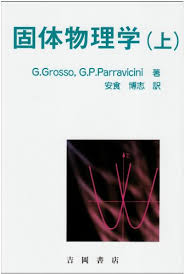
固体物理学〈上〉(物理学叢書)固体物理学〈上〉 (Solid State Physics, Vol. 1)
G. グロッソ, G. パストリ・パラヴィチーニ, G. Grosso and G. Pastori Parravicini, 吉岡書店
上巻は基本的な内容を扱っているので、基礎力強化のために何度でも読み直す価値があります (特に第4章まで)。
大学院生にもなると「第二量子化表示に慣れればよい」という風潮があり、 Hartree-Fock近似や、そこで学ぶべきクーロン項(直接積分)・交換項(交換積分)の概念を 第二量子化の言葉だけで理解している場合が多いように思います。しかし、これらを波動関数の言葉 ——Hartree-Fock近似なら single Slater determinant による多体変分波動関数——で 理解しておくことはとても大事で、両者が同じものだと分かって初めて第二量子化の利点に 気づけるのだと思っています。その意味で、本書の第4章はとても教育的です。
第5章は、5.3のOPW法から5.7のKKR法あたりはややマニアックな印象ですが、 ここまで丁寧な導出が付いているのは珍しく、第一原理計算の裏側を知れて楽しい部分です。 5.8.4の電子系の繰り込みはとても大事な概念で、これも丁寧に説明されていて大変ありがたい。 この前提知識があると、金属における Cooper pair の理解がすんなり進みます。
Volume 1 covers the fundamentals and is worth revisiting again and again (especially up to Chapter 4).
By graduate school there is a tendency to be content with second quantization, so many of us understand the Hartree-Fock approximation and the concepts it teaches — the Coulomb (direct) and exchange integrals — only in second-quantized language. But I find it very important to also understand them in the language of wave functions (for Hartree-Fock, a many-body variational wave function given by a single Slater determinant); only when you see that the two are the same thing do you truly appreciate the advantages of second quantization. In that sense, Chapter 4 of this book is wonderfully pedagogical.
In Chapter 5, the stretch from the OPW method (5.3) to the KKR method (5.7) feels a bit specialized, but derivations this careful are rare, and it is fun to see behind the scenes of first-principles calculations. The renormalization of electronic states in 5.8.4 is a crucial concept, also explained with great care — with this background, understanding Cooper pairs in metals comes naturally.
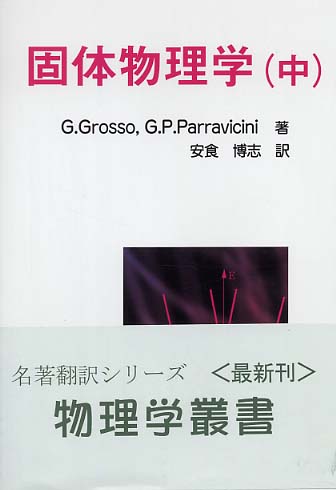
固体物理学〈中〉(物理学叢書)固体物理学〈中〉 (Solid State Physics, Vol. 2)
G. グロッソ, G. パストリ・パラヴィチーニ, G. Grosso and G. Pastori Parravicini, 吉岡書店
第7章では金属の誘電応答に焦点が当てられ、いわゆる Lindhard 関数が登場します。 大学院生になると Green 関数(あるいは Feynman ダイアグラム)から華麗に導出するのを習いますが、 そうしたテクニカルな道具に頼らなくても、摂動論(フェルミの黄金律)から導くことができます。 初めから Green 関数に頼るより、多少泥臭くてもこうした導出を経験しておいた方が 物理が分かる気がして、個人的にはとても有意義に感じます。
第8章では電子-原子核系と断熱原理が解説されますが、Jahn-Teller 効果の説明が端的で とても分かりやすいです。Jahn-Teller 効果というと、群論を用いた配位子場理論を マスターしないと理解できないような雰囲気があります(実際、配位子場理論はとても大事です)。 一方で、現象そのもの——雑に言えば、分子や結晶の対称性が高く、エネルギーの等しい 縮退軌道が存在すると、その構造が自発的に歪む現象——を大掴みに理解するには 本書を読むだけで十分ですし、読めば逆に、なぜ群論的な理解が必要なのかという モチベーションも見えてきます。
特に感動的なのは、8.5のパラメータを含むハミルトニアンと Berry 位相についての解説です。Jahn-Teller 効果の議論が幾何学的 Berry 位相の立場から 見直せる——私はこの本を通じてその事実に気付かされました。 さらに8.6では電気分極と Berry 位相が扱われます。今でこそこの関係は複数の トポロジカル物性の教科書で言及されていますが、固体物理の教科書で基礎を身につけながら こうした発展的な概念まで学べるのはとてもよいことだと思います。
第9章は比較的標準的な格子振動の話です。ただし、付録Aの線形調和振動子の量子論の補足に 出てくる Weyl の恒等式や Bloch の恒等式は、一見ただの算数なのですが、後々ほかの本で 勉強を進めると、これがキュムラント展開に対応し、さらに摂動論で使う Wick 分解と つながっていることに気づきます。片隅の知識が繋がるこの感覚はとても面白いものでした。
第11章の金属の光学的性質と輸送現象は、下で紹介している浅野先生『固体電子の量子論』の 第8章「物質の電磁気学」・第9章「金属の電気伝導と光学応答」と相性がよく、 互いに相補的な記述になっています。比較しながら読むととても勉強になりました。
Chapter 7 focuses on the dielectric response of metals, where the Lindhard function makes its appearance. In graduate school one learns to derive it elegantly from Green's functions (or Feynman diagrams), but it can also be obtained without such technical machinery, from perturbation theory (Fermi's golden rule). I find it very worthwhile to go through this somewhat down-to-earth derivation before relying on Green's functions — it gives you a better feel for the physics.
Chapter 8 treats the electron-nucleus system and the adiabatic principle, with a remarkably clear and compact explanation of the Jahn-Teller effect. The Jahn-Teller effect has an aura of requiring mastery of group theory and ligand field theory (which is indeed important), but for a first understanding of the phenomenon itself — roughly, that a highly symmetric molecule or crystal with degenerate orbitals spontaneously distorts — this book alone is quite sufficient, and reading it also motivates why the group-theoretical understanding is needed.
What moved me most is Section 8.5 on Hamiltonians with parameters and the Berry phase: the Jahn-Teller problem can be revisited from the viewpoint of the geometric Berry phase — a fact this book made me realize. Section 8.6 then covers electric polarization and the Berry phase. Nowadays this connection appears in several textbooks on topological matter, but it is a great thing to encounter such advanced concepts while building up the basics in a solid state physics textbook.
Chapter 9 is a fairly standard account of lattice vibrations — though the Weyl and Bloch identities in Appendix A's supplement on the quantum harmonic oscillator, seemingly mere arithmetic, later turn out to correspond to the cumulant expansion and, further, to the Wick decomposition used in perturbation theory. The moment these scattered pieces of knowledge connect is a real delight.
Chapter 11 on the optical and transport properties of metals pairs beautifully with Chapters 8 and 9 of Asano's 固体電子の量子論 (introduced below); the two accounts are complementary, and reading them side by side taught me a lot.
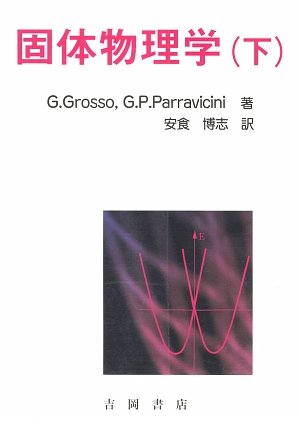
固体物理学〈下〉(物理学叢書)固体物理学〈下〉 (Solid State Physics, Vol. 3)
G. グロッソ, G. パストリ・パラヴィチーニ, G. Grosso and G. Pastori Parravicini, 吉岡書店
下巻は第16章と第17章しか読んでいませんが、その範囲だけでも紹介したいことが多くあります。
第16章では、16.5から展開される近藤問題の説明がかなり平易に書かれており、 近藤問題を勉強するときに最初に読む文献としておすすめです。 16.6.3では、近藤相互作用の微視的な起源を「分子模型」というシンプルな模型で解説していて、 近藤現象の本質的な性質が浮き彫りになり面白いです。さらに16.7では、 上巻5.8.4の電子系の繰り込み法を用いて、極低温での一重項束縛状態の形成が 理解できるように工夫されています。
第17章は比較的標準的な磁性の解説です。この手の初歩的な固体物理の教科書として 珍しいと思うのは、17.6で Ising 模型を例にした繰り込み群理論が紹介されている点です。 内容は初歩的ですが、初めて勉強する場合には丁寧で参考になると思います。
I have only read Chapters 16 and 17 of Volume 3, but even that much gives me plenty to recommend.
In Chapter 16, the discussion of the Kondo problem developed from Section 16.5 is written in remarkably plain terms — I would recommend it as the first thing to read when studying the Kondo problem. Section 16.6.3 explains the microscopic origin of the Kondo interaction using a simple "molecular model," which nicely lays bare the essential nature of the Kondo effect. Section 16.7 then uses the renormalization method for electronic states from Vol. 1 (Section 5.8.4) to make the formation of the singlet bound state at very low temperatures accessible.
Chapter 17 is a fairly standard account of magnetism. What is unusual for an introductory solid state textbook of this kind is Section 17.6, which introduces renormalization-group theory using the Ising model as an example. The treatment is elementary, but careful enough to be a helpful first encounter with the subject.
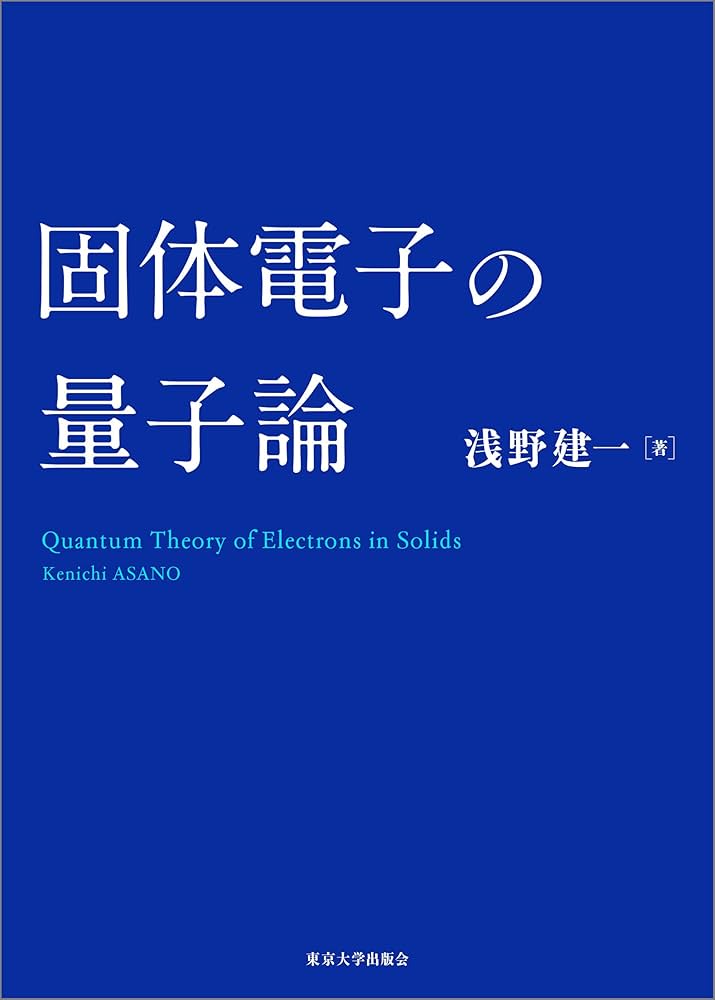
固体電子の量子論固体電子の量子論 (Quantum Theory of Electrons in Solids)
浅野建一, K. Asano, 東京大学出版会
全体で500ページほど、物性物理学の研究を志す学部生・大学院生を対象とした本です。 「この本はあくまで辞書代わり」という評価(もちろん否定的な意味ではなく、 使い方についての意見でしょう)が Amazon レビューをはじめ散見されますが、 私は、この本で勉強するなら1ページ目から全部フォローするべきだと思っています。 決してつまみ読みできる類の本ではありません。例えば第III部の固体の電磁応答は、 第I部第4章の線形応答の量子論を読んでいることが前提ですし、 第9〜11章の電気伝導や光学応答も、第8章で導入される電磁応答核の議論なしには 理解できないはずです。
一方でこの本のすごいところは、緒言で著者自身が述べているように、 教科書として自己完結しており、概念や手法を身につけるのに他書を参照する必要がない 構成になっていることです。第I部から順に読んでいくと、読み切ったあとに、 本当にその言葉どおりの自己完結型の専門書であることに気づきます。
なお、Feynman ダイアグラムを用いた摂動論は本書では扱われません。 これも緒言で著者が述べているように、Green 関数の摂動論を学ぶ際には 計算技法にばかり目が行き、肝心の物理的意味を見失いがちです (この見解は真っ当で、多くの大学院生が陥る罠だと思っています)。 基礎的な線形応答(久保公式)の理解から金属の誘電応答(Lindhard 関数など)が どのように導かれるのか、そしてその応答関数からどんな物理現象が導かれるのか—— Green 関数に頼らずに本書で身につけておくことが、 後々ダイアグラムを理解する際の大きな助けになるはずです。
本書の特徴のひとつは線形応答理論だと思います。第4章の解説はとても明快で、 適用上の注意点や、他書なら脚注に回るような事柄まで懇切丁寧に書かれています。 カノニカル相関を用いた久保公式の表現など、教科書では細かく説明されないのに 論文ではよく出会うものまで、きちんと導出付きで紹介されているのが大変ありがたい。
第III部の固体の電磁応答も丁寧に理論が展開されていて、読んでいてとても楽しい部分です。 最終的に Drude 重みと Meissner 重みの考え方がすっきり理解できるようになっていて、 第8章は個人的にこの本で一番好きな章です。
第VI部の量子Hall効果も大変勉強になりました。 量子Hall効果に興味を持ったら、まずこの二章分を読むことをおすすめします。 第18章は整数量子Hall効果で、Widom-Středa 公式のような「教科書では細かく説明されないが 論文ではよく出会う」ものの解説がしっかり書かれているのがありがたい。 第19章の分数量子Hall効果も、本質を掴むにはまずこの本から入るのが最速だと思っています。 本当に本質的で大事なことが30ページほどで、しかも大変丁寧な説明と計算過程付きで コンパクトにまとまっています。
A book of roughly 500 pages aimed at undergraduate and graduate students heading into condensed matter research. One often sees the assessment — on Amazon reviews and elsewhere — that this book is "best used as a reference" (not a negative judgment, of course, just an opinion about usage). I disagree: if you study from this book, you should follow it from page one. It is not a book for cherry-picking. For instance, Part III on the electromagnetic response of solids presupposes the quantum theory of linear response in Chapter 4, and Chapters 9–11 on conduction and optical response cannot be understood without the response-kernel discussion of Chapter 8.
What is remarkable, as the author himself notes in the preface, is that the book is completely self-contained — you never need another reference to master its concepts and methods. Read it in order from Part I, and by the end you realize the claim is literally true.
Perturbation theory with Feynman diagrams is deliberately not covered. As the author notes, when learning Green's function perturbation theory one tends to fixate on computational technique and lose sight of the physics (a fair point, and a trap I believe many graduate students fall into). Learning here — without Green's functions — how the dielectric response of metals (e.g. the Lindhard function) emerges from basic linear response (the Kubo formula), and what physics the response functions encode, will later be a great help in understanding diagrams.
A signature strength of the book is its treatment of linear response theory. Chapter 4 is exceptionally clear, spelling out caveats and details that other books relegate to footnotes. Things like the canonical-correlation form of the Kubo formula — rarely explained carefully in textbooks yet ubiquitous in papers — are presented properly, derivations included.
Part III on the electromagnetic response of solids is developed with equal care and is a joy to read, culminating in a crisp understanding of the Drude and Meissner weights — Chapter 8 is my favorite in the book.
Part VI on the quantum Hall effect also taught me a great deal: if you become interested in the quantum Hall effect, these two chapters are where I would start. Chapter 18 (integer QHE) carefully explains things like the Widom-Středa formula, and Chapter 19 (fractional QHE) is, I believe, the fastest route to grasping the essentials — the truly important physics packed into about 30 pages, with meticulous explanations and worked calculations.
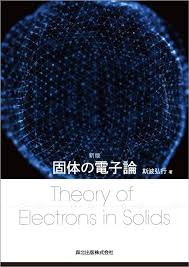
新版 固体の電子論新版 固体の電子論 (Electron Theory of Solids, New Edition)
斯波弘行, H. Shiba, 森北出版
大学院生が速習で固体物理学の基礎を勉強したいと思ったら、まずこの一冊を読むのがいいと思います。
とても基礎的な本ですが、Green 関数を用いず、摂動論だけで固体物理の王道ルート—— Mott 絶縁体、Fermi 液体、近藤効果、超伝導、遍歴電子系のスピン秩序——を 進んでいくのが本書の特徴です。摂動論しか使わないため学部3・4年生からでも 読めてしまうのに、この王道ルートを一通り歩めてしまう、とてもお得な本です。
スタートの敷居が低く、それでいて重要な固体物理の概念を総ざらいできる素晴らしい本ですが、 少し駆け足な部分もあるので、物理的な描像は他書で補うことが大切だと思います。
If a graduate student wants a fast track through the fundamentals of solid state physics, I would recommend reading this one book first.
It is a very basic book, but its distinctive feature is that it walks the royal road of solid state physics — Mott insulators, Fermi liquids, the Kondo effect, superconductivity, and spin order in itinerant electron systems — using nothing but perturbation theory, without Green's functions. Because only perturbation theory is required, even a third- or fourth-year undergraduate can read it, and yet you get to travel the entire royal road: a real bargain of a book.
The barrier to entry is low, and it still surveys the essential concepts of solid state physics — a wonderful book. It does move at a brisk pace in places, though, so it is important to supplement the physical picture with other references.
固体物理学(応用)Solid State Physics (Advanced)
この「応用」には二つの意味を込めています。ひとつは文字どおり advanced な (発展的で難しい)本。もうひとつは、磁性や超伝導など特定の分野に的を絞った 各論的な本です。こうした本は、固体物理学の「基礎」というより「応用」の 毛色が強いと思うので、こちらにまとめています。したがって、ここで紹介する本が 必ずしも難しいとは限らず、学部生や修士1年生でも読めるものも含まれています。 "Advanced" here carries two meanings. One is the literal sense — genuinely advanced, demanding books. The other is books devoted to a specific subfield, such as magnetism or superconductivity: these feel more "applied" than "foundational" to me, so I collect them here. Accordingly, the books in this group are not necessarily difficult — some are perfectly readable for undergraduates or first-year master's students.
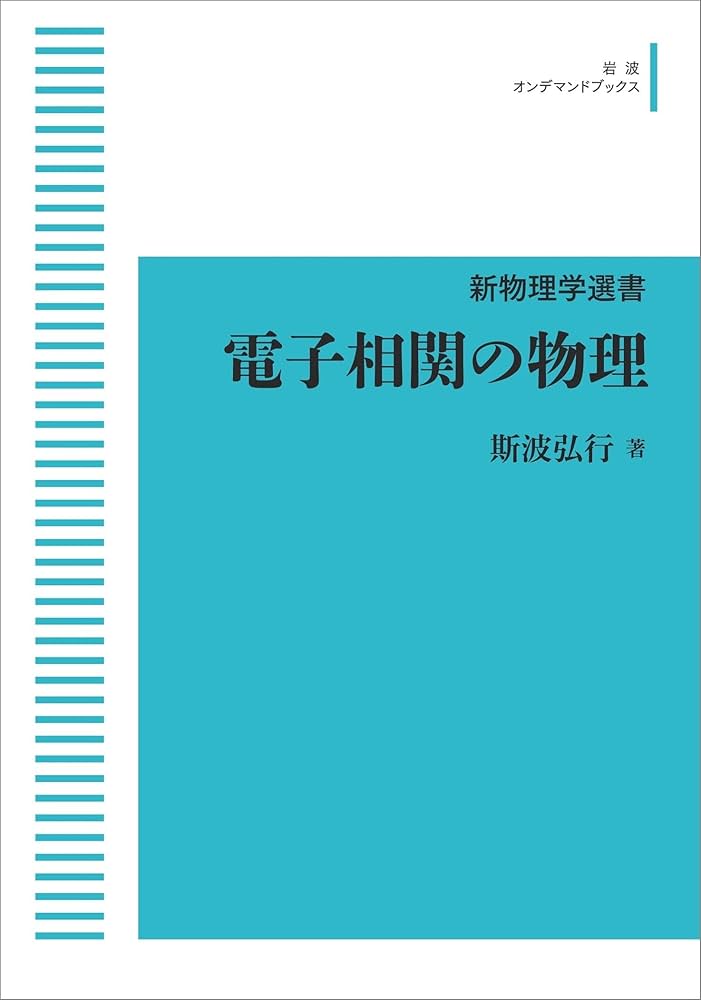
電子相関の物理(新物理学選書)電子相関の物理 (Physics of Electron Correlation)
斯波弘行, H. Shiba, 岩波書店(岩波オンデマンドブックス)
とてもいい本です。が、計算式のフォローがかなり難解な本でもあります。 斯波先生が書かれた別の二冊『基礎の固体物理学』『固体の電子論』は比較的平易な書かれ方で、 手に負えないような激しい式変形はあまり出てきませんが、この本は要注意です。 考えていたら一日が溶けるレベルの難解な式変形が出てきます(しかも計算の過程が飛んでいます)。 パラパラ読む分には何も問題ないのですが、導出をきちんと手で追うとなると大変で、 第1章を除けば、各章に最低二つ以上は、一日以上悩まないと解決できない式変形があります。 中には、他の教科書や引用されている原著論文まで引っ張ってきて、 一週間ばかりかけてようやく一つの式変形がわかる——特級呪物級の式変形もあります。
それでも、こういう諦めの悪さは研究ではとても大事ですし、 ここまで広範に電子相関の理論的な道具立てと諸現象を整理している本は珍しく、重宝しています。 一度理論を追ってしまえば、これほどコンパクトに重要事項が濃縮されている本は 他にないのではないかと思います。特に付録Aは、電子系の Green 関数と経路積分を 他書で詳しく学んだ人が自分の理解を整理したり深めたりするのに、 十分なエッセンスだけを濃縮して絞り出したような付録になっています。
分数量子Hall効果が載っていないことは少し残念ですが、 それ以外の電子相関に関する重要事項は「この一冊をマスターできればいい」と 言えるほどがっちりと書かれています。
強相関電子系は当然大変難しいわけですが、その難しさの一つに、 理論を制御する信頼できる展開パラメータが定義しにくいことが挙げられると思います。 これは強相関電子系の性質上どうしようもないことで、我々にできるのはとりあえず、 弱結合から攻めるか、強結合から攻めるかの二択です (補足すると、強相関電子系への弱結合からの展開は一見無意味にも見えますが、 低エネルギー現象を説明する分には依然として有効であることが多く、 現代的には断熱接続の原理、ないしくりこみという概念で理解されています)。 そしてこの両アプローチを満遍なく説明しているのが本書です。 この態度は、強相関電子系を理解する上で大変参考になります。 ちなみに親和性の高い類書として 山田耕作『電子相関』(現代物理学叢書、岩波書店) が挙げられます。山田先生の本はどちらかというと、弱相関的な立場から 固体の電子相関を理解することに主眼を置いた本と言えます。
今では式変形は一度追ってあるので、電車の中でゆっくり読書感覚で読める本になっていますが、 それでも特級呪物級の式変形の箇所に出会うたびに背筋が凍ります。
A very good book — and also a book whose calculations are seriously hard to follow. Shiba's other two textbooks, Fundamentals of Solid State Physics and Electron Theory of Solids, are written in a comparatively gentle style without wild derivations, but this one demands caution: it contains manipulations difficult enough to dissolve an entire day of thinking (with intermediate steps omitted, no less). Skimming is perfectly fine; following every derivation by hand is another matter. Outside Chapter 1, every chapter has at least a couple of derivations that take more than a day to crack, and a few — the special-grade-cursed-artifact class — took me a week each, digging through other textbooks and even the original papers cited.
Still, that kind of stubbornness is exactly what research demands, and few books organize such a broad range of theoretical tools and phenomena of electron correlation. Once you have worked through the theory, I doubt any other book packs the essentials this compactly. Appendix A in particular reads like the concentrated essence for anyone who has learned Green functions and path integrals for electron systems in detail elsewhere and wants to organize and deepen their understanding.
It is a little disappointing that the fractional quantum Hall effect is absent, but everything else that matters in electron correlation is covered so solidly that mastering this single volume would almost suffice.
Strongly correlated electrons are hard for many reasons; one is the difficulty of defining a reliable expansion parameter that controls the theory. Nothing can be done about that — our options are to attack from weak coupling or from strong coupling. (As an aside, weak-coupling expansions for strongly correlated systems may look pointless, yet they often remain valid for low-energy phenomena — an observation understood today through adiabatic continuity and the renormalization group.) This book explains both lines of attack evenhandedly, an attitude that is itself instructive. A closely related book is K. Yamada, Electron Correlation in Metals (Iwanami), which puts its main emphasis on understanding electron correlation in solids from the weakly correlated side.
Having traced the derivations once, I can now read it on the train at a leisurely, book-browsing pace — though a chill still runs down my spine every time I pass one of those special-grade cursed derivations.
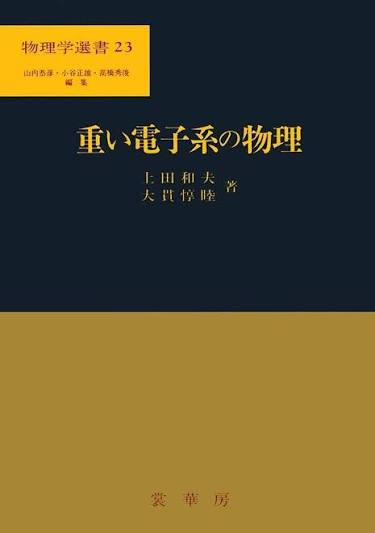
重い電子系の物理(物理学選書23)重い電子系の物理 (Physics of Heavy Electron Systems)
上田和夫, 大貫惇睦, K. Ueda and Y. Ōnuki, 裳華房
思い出深い一冊です。この本に出会うまで、私は実験と理論の接続というものに 憧れを抱いていながら、残念なことに、実験の論文を読んでも実験の方の研究発表を 聞いてもピンとこないことが多く、困っていました。本当は実験の豊富な超伝導などの 理論研究をしてみたいという憧れがあったのですが、理論と実験をつなぐ感覚が なかった自分には、とてもハードルが高かったのを覚えています。 そんな憧れを残しつつ、どちらかというと理論色の強い研究を続けてきたのですが、 やはり諦めきれずにいたところで出会ったのがこの本でした。
第4章「\(f\) 電子に対する実験手段」で、実験データの読み方というとても基礎的なことを 初めて学びました。むしろ、これまでちゃんと学んでこなかったのがもったいなかったと 思うくらい、実験手法と、それによって分かる物性の知識は視野を大きく広げてくれます。 自分にできることが増える感覚を持てるので、物性理論を研究している人にとって—— この本でなくてもよいのですが——実験をよく知ることは大事だと思います。 本書は15種類の実験手法を取り上げ、実験の図も豊富で、図をどう読むのか、 その実験から何が言えるのかを丁寧に解説してくれます。タイトルには 「\(f\) 電子に対する」とありますが、扱われる物質が\(f\) 電子系というだけで、 図の読み方とそこから得られることは普遍的なので、単に実験手法を学びたい 場合にも有益です。
一通り読んで、どの章も大変素晴らしかったのですが、第4章は自分が大きな影響を受けた、 特に気に入っている章です。出張にもよくこの本を持っていき、新幹線や飛行機の中で何度も 第4章を読み返しています。
Another book close to my heart. Before I met it, I had long admired the idea of connecting theory with experiment, yet — frustratingly — experimental papers and talks often failed to click for me. I dreamed of doing theory on experiment-rich subjects like superconductivity, but without a feel for the theory-experiment connection, the bar felt dauntingly high. I kept that longing while pursuing rather theory-flavored research, and, unable to give it up, I eventually found this book.
Chapter 4, on experimental probes of \(f\) electrons, taught me for the first time something utterly basic: how to read experimental data. Knowledge of experimental techniques and of the physics they reveal broadens your horizons so much that I only regret not learning it properly earlier. It gives you the feeling of your capabilities expanding, and I now believe that theorists in condensed matter — whether through this book or another — should know experiments well. The book covers fifteen experimental techniques with abundant experimental figures, carefully explaining how to read each plot and what each measurement can tell you. The title says "for \(f\) electrons," but only the materials are \(f\)-electron systems; how to read the figures and what to extract from them is universal, so the book is valuable even if you simply want to learn experimental methods.
I read the book cover to cover and every chapter is superb, but Chapter 4 is the one that influenced me most and the one I love best. I often carry this book on business trips and have reread Chapter 4 many times on trains and planes.
場の量子論Quantum Field Theory
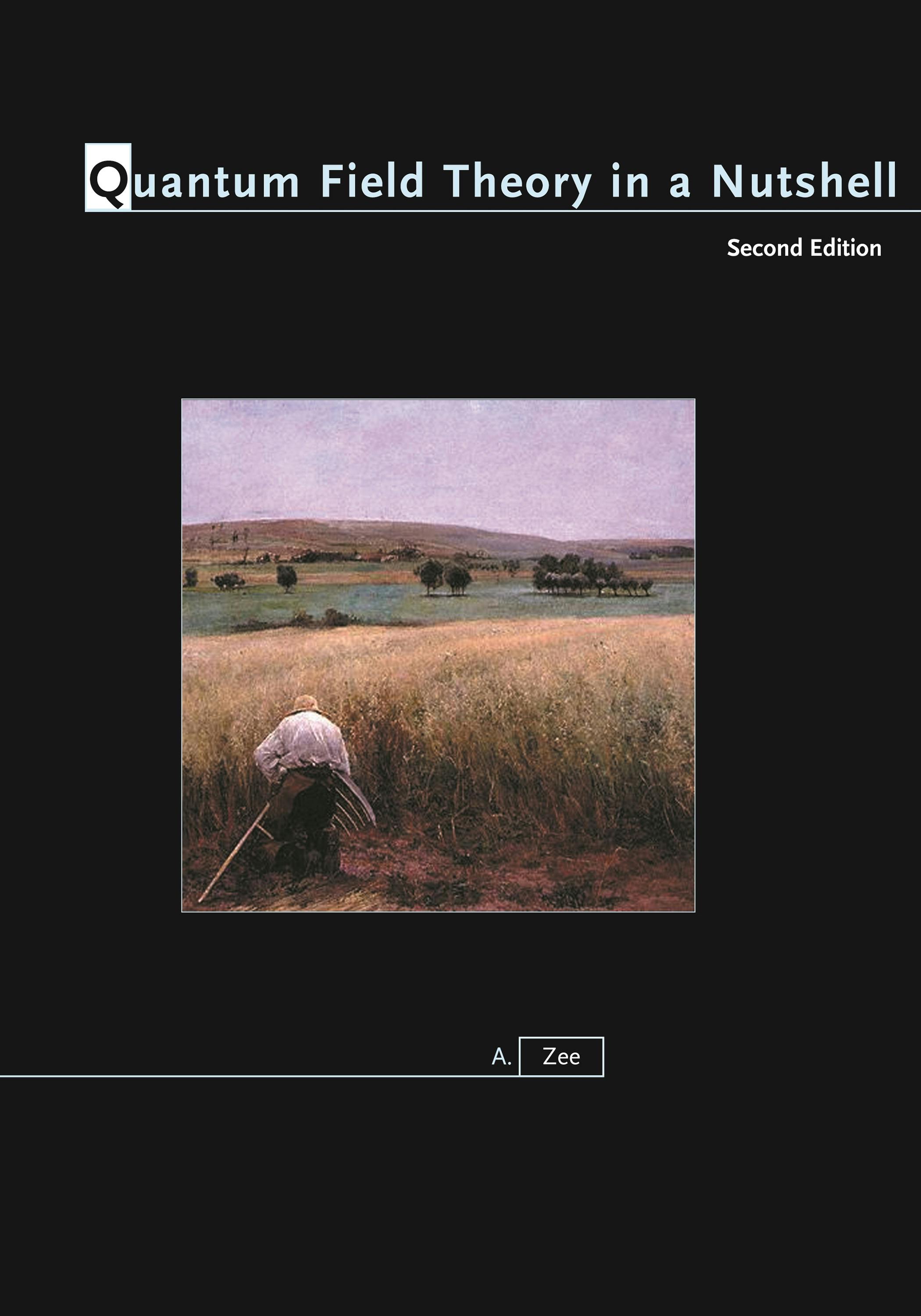
Quantum Field Theory in a Nutshell
A. Zee, Princeton University Press (2nd ed., 2010)
学部生のときに輪読した場の量子論の教科書です。 経路積分から場の量子論に入門し、ファインマンダイアグラム、対称性の議論へと、 かなり初歩的なところから始まって、第I部だけで場の理論の全体像が見渡せる構成になっています。 続く第II部で Dirac 場、第III部でくりこみ理論へとテンポよく進むので、読んでいて楽しい本です。
第IV部では自発的対称性の破れが解説され、あわせて、少し毛色の違う量子異常——古典的には 対称性があり保存則が存在すると期待されるのに、量子化した理論ではその対称性が失われ、 保存量が存在しなくなる現象——も紹介されます。
第V部のテーマは場の理論と集団現象で、超流動・超伝導・有限温度の場の理論が扱われ、 物性物理学との関わりが深い部分です。続く第VI部でも凝縮系物理との関連が続き、 量子ホール流体やくりこみ群のフローなど、物性理論で重要になる概念を効率よく学べます。
A QFT textbook I read in a study group as an undergraduate. It introduces field theory through the path integral and moves on to Feynman diagrams and symmetry arguments, so that Part I alone gives you a bird's-eye view of the whole subject starting from the very basics. Part II covers the Dirac field and Part III renormalization at a brisk, enjoyable pace.
Part IV discusses spontaneous symmetry breaking, together with quantum anomalies — phenomena where a symmetry expected classically, along with its conservation law, fails to survive quantization.
Part V turns to field theory and collective phenomena — superfluidity, superconductivity, and finite-temperature field theory — with deep ties to condensed matter physics, and Part VI continues in this direction, efficiently covering concepts essential to condensed matter theory such as quantum Hall fluids and renormalization-group flows.
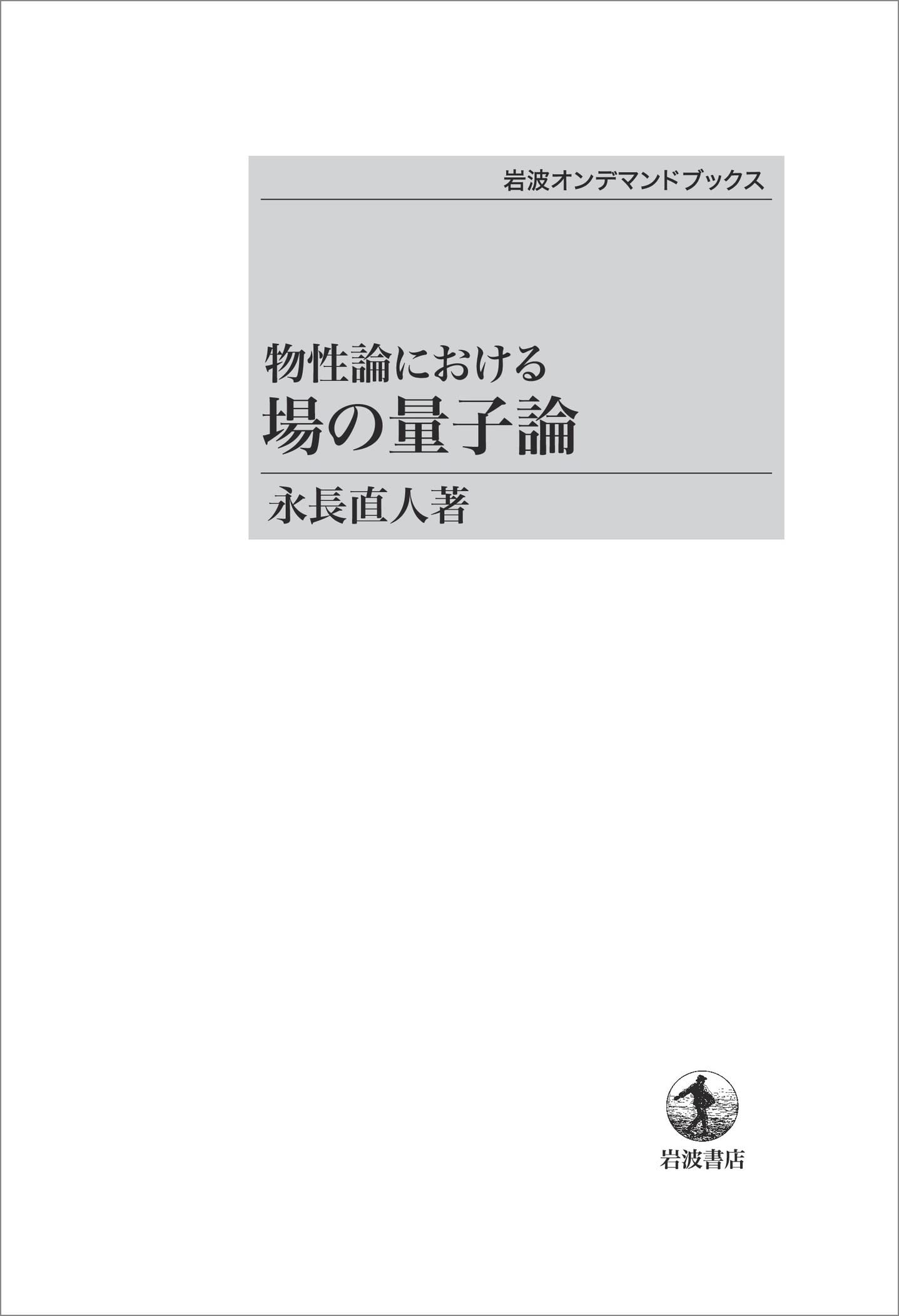
物性論における場の量子論物性論における場の量子論 (Quantum Field Theory in Condensed Matter Physics)
永長直人, N. Nagaosa, 岩波書店(岩波オンデマンドブックス)
修士1年のときの輪読の教科書でした。場の量子論を用いた物性物理学の本ですが、 主役は多体摂動論ではなく経路積分です。物性物理学の諸現象——特に第4章・第5章で扱われる クーロンガス、Bogoliubov 超流動、超伝導——を経路積分形式で理解していく流れは とても参考になります。
そして何より、これほど理論色の強い本でありながら、言葉での説明がとても多いのが特徴です。 時折比喩を交えながら、数式の意味や得られた結論を噛み砕いてくれて、 「これが理論物理学だ」と思えるくらい、物理現象と数式と自分のイメージが 一緒に育っていく、とてもいい本でした。
3.4の格子ゲージ理論と閉じ込め問題は、私の博士課程での研究(量子スピン液体)でも 基礎的な考え方になっているので、J. B. Kogut による格子ゲージ理論の入門的レビュー論文と あわせて何度も読み返しました。
第6章の量子ホール液体と Chern-Simons ゲージ場も、何回読んでも面白いと思える 説明・論理の構成になっています。分数量子ホール効果と、その低エネルギー有効理論としての Chern-Simons 理論に魅了されたのは、この本のおかげです。
This was our reading-group textbook in my first year of the master's course. It is a book on condensed matter physics built on quantum field theory, but the protagonist is the path integral rather than many-body perturbation theory. The way it develops phenomena of condensed matter — notably the Coulomb gas, Bogoliubov superfluidity, and superconductivity in Chapters 4 and 5 — in the path-integral language is highly instructive.
Above all, for such a theory-heavy book it is remarkably generous with verbal explanations. It breaks down the meaning of the equations and their conclusions, sometimes with the help of analogies, so that physical phenomena, formulas, and your own mental picture grow together — the kind of book that makes you feel "this is theoretical physics."
Section 3.4 on lattice gauge theory and the confinement problem has become a foundational idea in my own Ph.D. research on quantum spin liquids, and I have returned to it many times together with J. B. Kogut's introductory review on lattice gauge theory.
Chapter 6 on quantum Hall liquids and the Chern-Simons gauge field is constructed so well that it stays interesting no matter how many times you read it. It is thanks to this book that I fell for the fractional quantum Hall effect and its low-energy effective description, Chern-Simons theory.
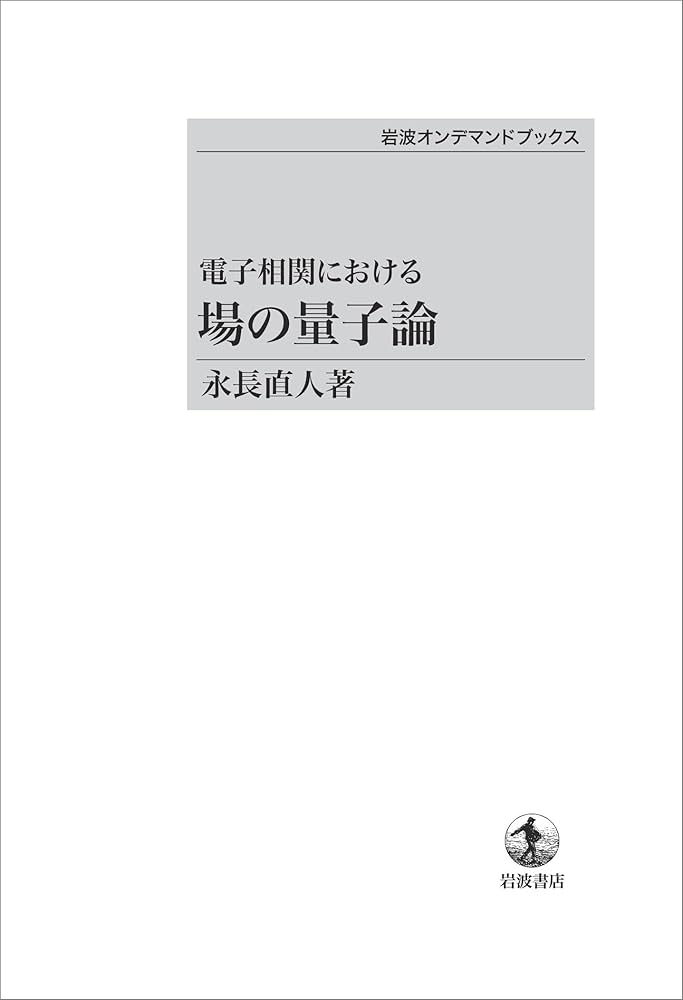
電子相関における場の量子論電子相関における場の量子論 (Quantum Field Theory in Strongly Correlated Electronic Systems)
永長直人, N. Nagaosa, 岩波書店(岩波オンデマンドブックス)
上で紹介した『物性論における場の量子論』の知識を前提とした、より高度な内容を扱う本です。 全章どれもわかりやすく刺激的な内容ばかりですが、特に第3章と第4章は一読の価値があります (本当は何度でも読み返すのがよいと思います)。
第3章は、強相関電子系のエッセンスが50ページに濃縮されています。 第4章は「局所的電子相関」と題して、近藤問題から動的平均場理論まで丁寧に理論が 展開されます。局所的電子相関は、一次元系と並んでよく理解されている理論ですが、 より一般の難しい強相関電子系を考察する際に、重要な示唆を数多く与えてくれます。
これは趣味嗜好やバックグラウンドに強く依存する話だと思いますが、私は研究で 行き詰まったり気持ちが落ちたりしたとき、この本の第3章や第4章を読んで、 難しいことに挑戦するワクワクを思い返すようにしています。その意味で、 精神安定剤のような役割をしてくれている、とても気に入っている本です。
ただし、第1章と、第2章の2-1・2-2をこの本だけで理解するのは難しいと思うので、 川上・梁『共形場理論と1次元量子系』や藤本・川上『量子多体系の物理』あたりと 併読することをおすすめします。
A more advanced book that presupposes the material of 物性論における場の量子論 introduced above. Every chapter is lucid and stimulating, but Chapters 3 and 4 in particular are worth reading (in truth, worth rereading many times).
Chapter 3 condenses the essence of strongly correlated electron systems into some 50 pages. Chapter 4, titled "Local electron correlation," develops the theory carefully from the Kondo problem to dynamical mean-field theory. Local electron correlation is, alongside one-dimensional systems, one of the best-understood corners of the field, and it offers many important insights when tackling more general, harder problems in strongly correlated electrons.
This surely depends on one's taste and background, but when my research stalls or my spirits drop, I read Chapters 3 and 4 of this book to remind myself of the thrill of taking on hard problems. In that sense it serves as a kind of tranquilizer for me — a book I am very fond of.
That said, Chapter 1 and Sections 2-1 and 2-2 of Chapter 2 are hard to digest from this book alone; I recommend reading them alongside Kawakami & Yang, 共形場理論と1次元量子系, and Fujimoto & Kawakami, 量子多体系の物理.
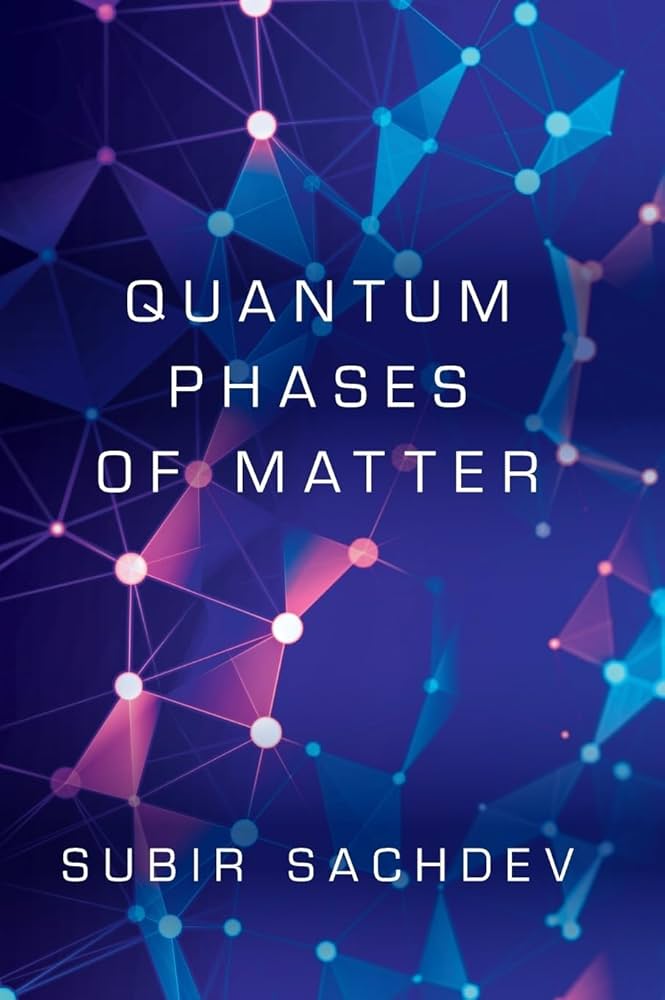
Quantum Phases of Matter
S. Sachdev, Cambridge University Press
この本がなかったら博士課程の研究が始まらなかったかもしれない、 というレベルでお世話になった本です。
お気に入りの Schwinger boson 法そのものについては、まず原著論文の D. P. Arovas and A. Auerbach, Phys. Rev. B 38, 316 (1988) を読むのが 一番教育的だと思いますが、本書は、その先にある格子ゲージ理論的な見方から、 強相関電子系・量子スピン液体の広がりとその可能性を見据えることのできる本です。
とりわけ Part IV の、fractionalization と band topology を結びつける部分が 私の興味と重なっていたので、Part IV までを一通り読みました。 この Part IV の考え方を Schwinger boson 法に応用して熱ホール効果を計算する、 といったことも研究テーマの一つとして興味を持っています。
2025年にカナダ・モントリオールで開かれた強相関電子系国際会議 (International Conference on Strongly Correlated Electron Systems, SCES 2025)で 著者の Subir Sachdev 先生のトークを拝聴しましたが、correlated metals に対してもこうした考え方を 深めておられて大変興味深く、本当は Part V も読みたいと思っています…。
This book helped me to the point that, without it, my Ph.D. research might never have gotten off the ground.
For the Schwinger boson method itself — my favorite tool — the most instructive first read is still the original paper, D. P. Arovas and A. Auerbach, Phys. Rev. B 38, 316 (1988). What this book offers lies beyond that: a lattice-gauge-theoretical vantage point from which you can survey the breadth and promise of strongly correlated electrons and quantum spin liquids.
Part IV, which ties fractionalization to band topology, overlapped squarely with my own interests, so I read the book through Part IV. Applying the ideas of Part IV to the Schwinger boson method to compute thermal Hall effects is one of the research directions I am interested in.
At the International Conference on Strongly Correlated Electron Systems (SCES 2025) in Montreal, I attended a talk by the author, Subir Sachdev, who is extending this way of thinking to correlated metals — fascinating, and a reminder that I really ought to read Part V as well...
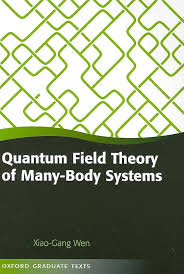
Quantum Field Theory of Many-Body Systems
X.-G. Wen, Oxford University Press
この本も、上で紹介した S. Sachdev 著 Quantum Phases of Matter と同じく、 私の博士課程の研究に必要な概念を学ぶうえでとても重要だった教科書です。
量子スピン液体の分類学に PSG(Projective Symmetry Group)という群論的な 考え方がありますが、それについて丁寧に書かれた本です。PSG そのものは本当に 「分類学」の仕事になってしまうので(PSG 解析をしただけで一つの論文になります)、 分類学そのものよりもスピンダイナミクスなどの動的な物性に興味がある私は PSG の研究はしていませんが、この本のおかげで先行研究の理解度が圧倒的に 増したのは事実です。さらに、スピンダイナミクスの研究においても重要になる IGG(Invariant Gauge Group)という概念も、この教科書で学べます。
とてもよく書かれた教科書ですが、ある意味で、著者の思考や信念のようなものが 強く感じられます。自分もこんな、物理に対する強い信念を持ちたいなと 思わせてくれる本でした。読んだあとしばらくの間、「物理学の変換はすべて ゲージ変換なのではないか」と思ってしまうくらい、多大な影響を受けた一冊です。
Like Sachdev's Quantum Phases of Matter above, this textbook was essential for learning the concepts my Ph.D. research is built on.
In the taxonomy of quantum spin liquids there is a group-theoretical framework called the PSG (Projective Symmetry Group), and this book treats it with great care. PSG analysis is classification work in the truest sense — a PSG analysis alone can constitute a paper — and since my own interest lies in dynamical properties such as spin dynamics rather than in taxonomy itself, I have not pursued PSG research. Still, this book unquestionably deepened my understanding of the literature by an order of magnitude. It also teaches the IGG (Invariant Gauge Group), a concept that matters for studies of spin dynamics as well.
It is a beautifully written textbook, and at the same time you can feel the author's own thinking and convictions running through it — the kind of book that makes you want to hold such strong convictions about physics yourself. For a while after reading it, I caught myself thinking that perhaps every transformation in physics is a gauge transformation. That is how much this book influenced me.
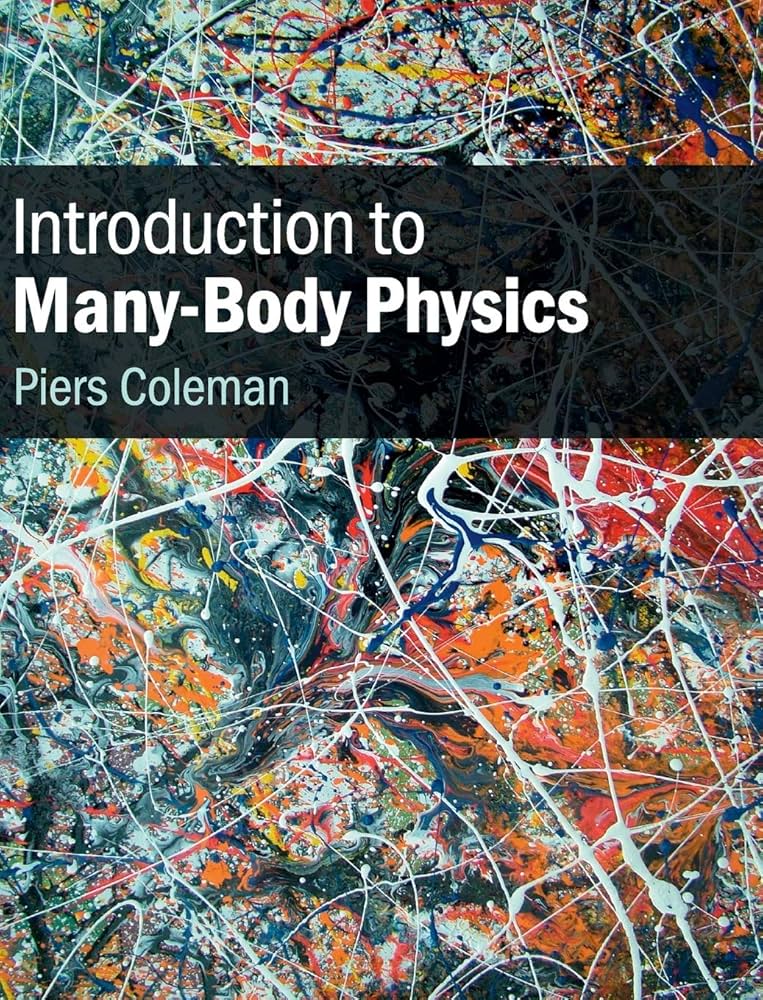
Introduction to Many-Body Physics
P. Coleman, Cambridge University Press
第12章から第18章まで、その後に第9章、という順で読みました (第9章の理論と実験の接続の話も個人的には大変面白かったのですが、 以下では紹介を割愛します)。ほかの章は未読なのでコメントできませんが、 もともとは path integral をこの本で勉強してみようという気持ちで手に取りました。
第12章は path integral の基本的な説明で、coherent state の性質から始めて Hubbard-Stratonovich 変換まで、基本概念と計算方法が紹介されます。 第13章は経路積分の遍歴磁性体への応用で、これは物性の経路積分の本 (永長直人『物性論における場の量子論』、Altland & Simons Condensed Matter Field Theory など)でもなかなか取り上げられていない例で、 とても参考になります。永長直人『電子相関における場の量子論』の3-3でも 扱われていますが、やや駆け足気味なので、ダイアグラムとの対応まできちんと 勉強したい場合は本書の方が親切です。
第14章の超伝導は、BCS 理論の経路積分による標準的な説明で、他書でもよく見かける 議論です。一方、第15章では遅延効果と異方的電子対について詳しい解説があります。 \(d\)-wave の銅酸化物超伝導の話もあり、個人的に興味があったので楽しみながら読めました。 15.5には超流動の説明もあり、読み進めると最後には芳田奎先生に由来する Yosida 関数まで説明されています。
第16章から第18章にかけてが、この本の醍醐味だと思います。著者の Piers Coleman は 重い電子系の大家で、その本人による近藤問題・重い電子系の解説が展開されていて圧巻です。 私自身はこの本を通じて、近藤問題という比較的よく理解されている局所的電子相関の 問題から実に多くのことが示唆されること、そしてその示唆を手がかりに、難題である 重い電子系へ物理的な直感を持ってアプローチできることを学びました。 よく理解されていることを深く理解して、未解明の物理に果敢に挑んでいく—— この姿勢はまさに Coleman だからこそ書けるものだと思いますし、研究においては 「わかっていること ≠ つまらない・やる必要のないこと」なのだと強く実感しました。
第18章は、slave boson 法を Coleman 自身が解説してくれるありがたい章です。 私の研究手法にも少し関連があり、大変参考になりました。18.7には トポロジカル近藤絶縁体の話まで書かれていて、かなり盛りだくさんの章ですが、 この本でしか味わえない魅力がある気がしています。
I read Chapters 12 through 18 in order, followed by Chapter 9 (whose discussion of connecting theory to experiment I also found fascinating, though I omit it below). I have not read the other chapters and cannot comment on them; I originally picked up this book intending to learn path integrals from it.
Chapter 12 is a foundational account of path integrals, starting from the properties of coherent states and proceeding to the Hubbard-Stratonovich transformation. Chapter 13 applies the path integral to itinerant magnetism — an example rarely treated in other condensed matter path-integral texts (Nagaosa's 物性論における場の量子論, Altland & Simons, etc.), and very instructive. Nagaosa's 電子相関における場の量子論 covers it in Section 3-3, but at a brisk pace; if you want to work out the correspondence with diagrams properly, this book is the kinder guide.
Chapter 14 gives the standard path-integral treatment of BCS superconductivity, familiar from other books. Chapter 15, on the other hand, offers a detailed discussion of retardation and anisotropic pairing, including \(d\)-wave superconductivity in the cuprates — a personal interest of mine, so it was a pleasure to read. Section 15.5 covers superfluidity, and by the end you even find the Yosida function of Kazumi Yosida explained.
Chapters 16 through 18 are, I think, the heart of this book. Piers Coleman is a master of heavy-fermion physics, and his own exposition of the Kondo problem and heavy fermions is magnificent. Through this book I learned how much is implied by the Kondo problem — a comparatively well-understood case of local electron correlation — and how those insights allow a physically intuitive approach to the hard problem of heavy fermions. Understanding the well-understood deeply, and then daring to attack unsolved physics: only Coleman could write it this way, and it brought home to me that in research, "understood" does not mean "boring" or "not worth doing."
Chapter 18 is a gift: the slave boson method explained by Coleman himself. It relates to my own research methods and taught me a great deal. Section 18.7 even covers topological Kondo insulators — a packed chapter with a flavor you can find nowhere else.
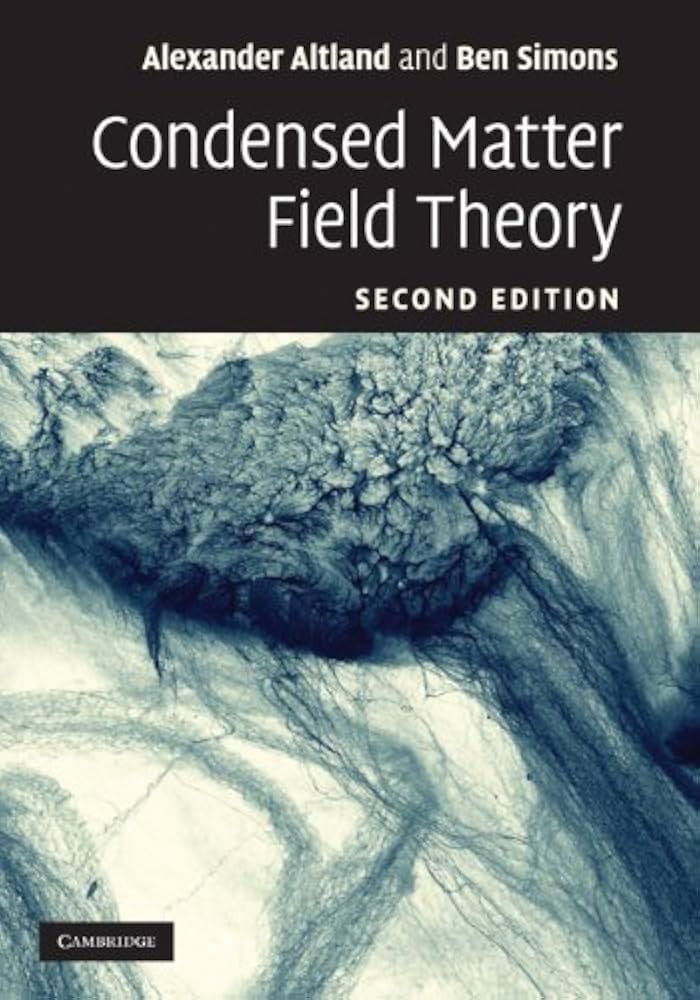
Condensed Matter Field Theory
A. Altland and B. D. Simons, Cambridge University Press
色々なことが載っていて、読んでいて楽しい本です(前半は、自分はつまみ読みしか していません)。場の量子論を用いた物性物理学の本ですが、Green 関数の摂動論が メインテーマというわけではなく、幅広い手法が紹介されます。
経路積分は、摂動展開を比較的簡単に実行する手法を提供してくれるのはもちろんですが、 個人的には、非自明な参照基底状態を決定し、そこからの集団励起を低エネルギー 有効理論として構築する手続きを半自動化してくれることにこそ強みがあると感じています。 そうした例は第6章で学ぶことができます。また第5章では、大変教育的な例を通して 摂動展開の注意点が整理されています。摂動展開は Taylor 展開とは質的に異なるものであり、 Green 関数の摂動論が与える結果の漸近的性質を心に留めておくことの重要性に 注意を喚起してくれます。
後半の第8章から第11章は、しっかり読みました。第8章は繰り込み群です。 繰り込み群を本格的に勉強したい場合は、臨界現象に焦点を置いた本を一冊読む方が 重要だと個人的には考えていますが、それでも本章は繰り込み群のクラッシュコースとして 重要な文献だと感じます。基礎的なモチベーションの説明に続けて複数の適用例が 紹介されるので、他の本で勉強した後に眺めるのが一番楽しいのではないかと思います。
第9章「トポロジー」はトポロジカル項の解説で、個人的に一番気に入っている章です。 トポロジーというと、多くの教科書では Berry 接続・Berry 位相の定義から始まることが 多いですが、本書の構成はオリジナリティにあふれています。低エネルギー場の理論に 影響を与えるトポロジカル項——\(\theta\) 項、Wess-Zumino 項、Chern-Simons 項——が 一つずつ節を分けて紹介されていき、最終的にそれらと物性のつながりが見えてくる 構成になっていて、この教科書でしか学べないトポロジカル物性の整理のされ方が 気に入っています。物理としては具体的に、永久電流、スピン鎖における Haldane 予想、 整数量子Hall効果、Berry 位相、分数量子Hall効果が紹介されます。
第10章と第11章では、非平衡がそれぞれ古典論・量子論で説明されます。 第10章は前半までしか読めておらず、後半は時間を見つけて読みたいと思っています。 第11章では Keldysh 法を学び、量子輸送問題に適用します。量子マスター方程式や Keldysh 法の基礎が学べるようになっていて、準古典近似に関する説明は、 quantum kinetic theory を用いた輸送(非線形応答や非平衡下での輸送)を理解するうえで かなり参考になると思います。
A book packed with good things — a pleasure to read (I have only skimmed the first half). It is a book on condensed matter physics via quantum field theory, but Green's function perturbation theory is not the main theme: a wide range of methods is presented.
The path integral of course provides a relatively easy route to perturbative expansions, but to me its real strength lies in semi-automating the procedure of identifying a nontrivial reference ground state and constructing the collective excitations above it as a low-energy effective theory — examples of which you can learn in Chapter 6. Chapter 5, through very instructive examples, organizes the caveats of perturbative expansions: a perturbation series is qualitatively different from a Taylor series, and the book alerts you to keep in mind the asymptotic nature of the results that Green's function perturbation theory delivers.
I read Chapters 8 through 11 carefully. Chapter 8 treats the renormalization group. If you want to study the RG seriously, I personally think reading a book focused on critical phenomena matters more — yet this chapter remains an important reference as an RG crash course. It motivates the basics and then presents several applications, so it is perhaps most enjoyable to browse after studying the RG elsewhere.
Chapter 9, "Topology," is my favorite chapter. Where most textbooks on topology start from the definitions of the Berry connection and Berry phase, the construction here is full of originality: the topological terms that shape low-energy field theories — the \(\theta\) term, the Wess-Zumino term, and the Chern-Simons term — are introduced one by one in separate sections, and the connections to condensed matter physics emerge at the end. It is a way of organizing topological physics you can learn only from this textbook. Concretely, it covers persistent currents, the Haldane conjecture for spin chains, the integer quantum Hall effect, the Berry phase, and the fractional quantum Hall effect.
Chapters 10 and 11 treat nonequilibrium physics classically and quantum mechanically, respectively. I have only gotten through the first half of Chapter 10 and hope to find time for the rest. Chapter 11 develops the Keldysh method and applies it to quantum transport, covering the basics of quantum master equations and the Keldysh formalism; the discussion of the quasiclassical approximation should be quite helpful for understanding transport via quantum kinetic theory (nonlinear response and transport out of equilibrium).
トポロジカル物性Topological Phases of Matter
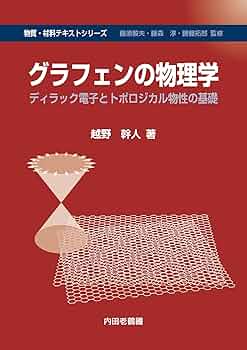
グラフェンの物理学 —ディラック電子とトポロジカル物性の基礎—グラフェンの物理学 (Physics of Graphene: Dirac Electrons and the Basics of Topological Phases)
越野幹人, M. Koshino, 内田老鶴圃(物質・材料テキストシリーズ)
とてつもなくわかりやすい本です。「グラフェンの物理学」というタイトルを見て、 グラフェンは自分の研究分野じゃないからと読まないのは、とてももったいない。 第一に、自分の分野でなくてもグラフェンは十分に楽しめます。 そして、こちらの理由の方が重要ですが、本書はグラフェンを大きな軸足にしつつ、 グラフェンとは無関係の物質にも使えるような、幅広い固体物理学の知識が拾える 構成になっています。
第2章で固体物理の基礎としてのバンド理論、第3章で電気伝導の理論、 第4章で磁場下での Landau 準位・量子ホール効果・軌道反磁性——と、 ありがたいくらい基礎から固体物理学を振り返ってくれます。 グラフェン中の低エネルギー電子は、運動量(波数)に線形な Dirac 分散と呼ばれる 分散関係を持ち、これに起因して、電気伝導・光学応答・磁場中の物性の振る舞いが、 我々のよく知っている電子系とは質的に異なります。本書の至れり尽くせりな点は、 そうした比較の前に、前提となる一般論を提示してくれることです。 例えば電気伝導であれば、グラフェンの電子とは関係のないレベルで成り立つ 線形応答理論の一般公式から始めてくれます。おかげで、どこに・どのような原因で グラフェンの特異性が現れるのかが分かりやすく、固体物理の知識そのものも深まります。
個人的に、電気伝導・光学応答の部分は浅野先生『固体電子の量子論』と親和性が高いので、 浅野先生の理論を学んだ後の応用例として本書の計算式をフォローするのがおすすめです。 本書には浅野先生の本では書かれていない Boltzmann 方程式を用いた記述もあるため、 両者は相補的です。
そして何よりわかりやすく教育的なのが、第5章から第7章のトポロジカル物性の 基礎概念の説明です。私が勉強した頃には本書はまだ出版されていませんでしたが、 いま初学で学ぶとしたら、第5章で Berry 位相の概念を学び、 第6章と第7章の結果を数値計算で再現するところから始めると思います。 それくらいわかりやすく書かれています。 もちろん趣味嗜好の問題はありますが、私は、SSH模型のもつトポロジカルな起源を Wannier 軌道中心と edge 状態から理解するのが一番教育的な整理の仕方だと 思っているので、越野先生のこの論理展開がとても気に入っています。 何度考えても、初学者がつまずかずにすんなり理解できるのは、この道筋だと思うのです。
Astonishingly clear. It would be a great waste to skip this book just because the title says "physics of graphene" and graphene is not your field. First, graphene is plenty enjoyable even if it is not your research area. Second — and this is the more important reason — while graphene is the book's main axis, it is structured so that you pick up a broad range of solid state physics applicable to materials that have nothing to do with graphene.
Chapter 2 reviews band theory as the foundation of solid state physics, Chapter 3 the theory of electrical conduction, and Chapter 4 Landau levels, the quantum Hall effect, and orbital diamagnetism in a magnetic field — a gratifyingly thorough refresher from the ground up. Low-energy electrons in graphene follow the Dirac dispersion, linear in momentum, which makes their conduction, optical response, and behavior in magnetic fields qualitatively different from the electron systems we know well. The book's generosity lies in presenting the general theory before any such comparison: for conduction, say, it starts from the general formulas of linear response theory, valid independently of graphene. As a result you see clearly where, and for what reason, graphene's peculiarities emerge — and your solid state physics deepens along the way.
Personally, I find the conduction and optical-response parts highly compatible with Asano's 固体電子の量子論: my recommendation is to follow this book's calculations as applications after learning the theory from Asano. This book also offers a Boltzmann-equation treatment absent from Asano's, so the two are complementary.
Above all, the explanation of the basic concepts of topological phases in Chapters 5–7 is wonderfully clear and pedagogical. The book had not yet been published when I first studied these topics, but if I were starting today, I would begin by learning the concept of the Berry phase in Chapter 5 and then reproducing the results of Chapters 6 and 7 numerically — it is that accessible. Tastes differ, of course, but I regard understanding the topological origin of the SSH model through Wannier centers and edge states as the most instructive way to organize the theory, which is why I am so fond of Koshino's line of reasoning. However many times I think it over, this is the path a beginner can walk without stumbling.
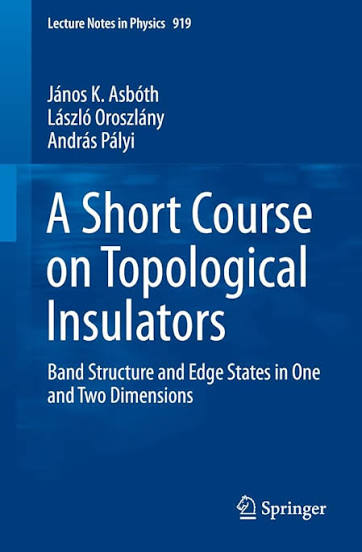
A Short Course on Topological Insulators
J. K. Asbóth, L. Oroszlány, and A. Pályi, Springer (Lecture Notes in Physics 919) — arXiv:1509.02295 から無料で入手できますalso freely available at arXiv:1509.02295
越野先生の『グラフェンの物理学』が出版されるまでは、個人的には この本が一番の初学者向けだと思っていました。
トポロジカル物性は、初見では難しそうな名前をしていますが、実際のところ バンド理論(tight-binding 模型)で十分実装可能な、比較的敷居の低い分野だと 思います(よほど、電子相関が本質的になる多体系の研究の方が難しいはずです)。 ただ、概念をぱらぱらと眺めているだけでは面白さが半減してしまうので、 数値計算で edge mode をプロットしてみたり、波動関数がエッジに局在する様子を 可視化してみることが何より重要だと感じています。しかも tight-binding 模型で 話が閉じているので、Kane-Mele 模型程度のバンド計算なら、自前のラップトップで 1分もかからずに回ります。
この本は SSH 模型から始まり、懇切丁寧に議論が展開されるので、数値計算での再現も かなり簡単にできる、とても有益な参考書です。私はこの本を読んで 「トポロジカル物性はこの順番で理解すればいいのか!」と気付かされました。 学部生や修士の学生がトポロジカル物性を勉強し始めるというときに 「SSH 模型から始めるとよい」と助言しているのですが、その姿勢は基本的に この本譲りです(もちろん、趣味嗜好の問題はあると思います)。
Until Koshino's グラフェンの物理学 was published, I personally considered this the best book for beginners.
Topological phases sound intimidating at first, but the field is in fact quite approachable: everything can be implemented within band theory (tight-binding models). If anything, many-body problems where electron correlation is essential are far harder. That said, merely leafing through the concepts robs the subject of half its fun — what matters most, I feel, is plotting edge modes numerically and visualizing how the wave functions localize at the edges. And since everything closes within tight-binding models, a band calculation for, say, the Kane-Mele model runs on your own laptop in under a minute.
Starting from the SSH model, this book develops the discussion with great care, which makes numerical reproduction remarkably easy — a genuinely useful reference. Reading it made me realize, "so this is the order in which to understand topological phases!" When undergraduates or master's students tell me they want to start learning the subject, I advise them to begin with the SSH model — an attitude I inherited, essentially, from this book (though tastes may differ, of course).
その他Miscellaneous
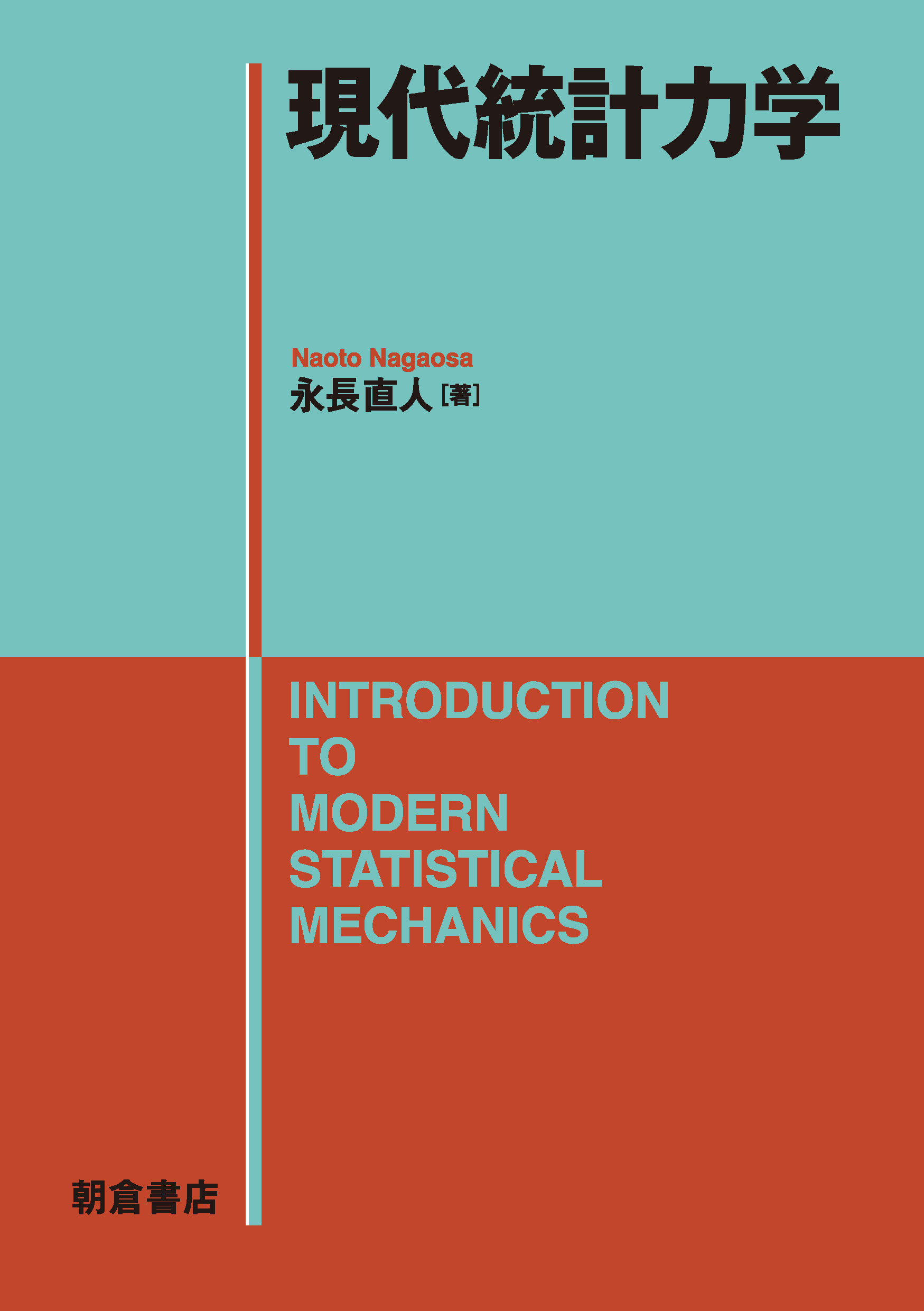
現代統計力学現代統計力学 (Introduction to Modern Statistical Mechanics)
永長直人, N. Nagaosa, 朝倉書店
量子力学と統計力学を一通り学んだ人が、タイトルどおり「現代」の統計力学を学ぶうえで とても参考になる本です。「現代」が何を含意しているのかは分かりませんが、 私としては、非平衡統計力学の進展と、情報理論との接続——この二つが 「現代」統計力学と呼ばれるものに相当するのではないかと思っています。
前者はこの本の第III部・第IV部に相当し、現代の我々の理解からは もはや基礎事項になりつつある非平衡統計力学の真髄をまとめてくれています。
後者については、第I部で情報と熱力学の関係や量子もつれの基礎的な内容が紹介されています。 また、本書で明示的に言及されているわけではありませんが、第IV部の動的臨界現象や ランダム系(スピングラス)の問題は量子情報とも繋がりが深く、 量子情報の論文を読む際には第IV部が前提知識になると思います。
For anyone who has been through quantum mechanics and statistical mechanics, this is a very helpful guide to "modern" statistical mechanics, as the title promises. I am not sure exactly what "modern" is meant to imply, but to my mind it corresponds to two things: the progress of nonequilibrium statistical mechanics, and the connection to information theory.
The former corresponds to Parts III and IV of this book, which distill the essence of nonequilibrium statistical mechanics — by now becoming standard material in our modern understanding.
As for the latter, Part I introduces the relation between information and thermodynamics and the basics of quantum entanglement. Moreover, though the book does not say so explicitly, the dynamical critical phenomena and random systems (spin glasses) of Part IV are deeply connected to quantum information — I would count Part IV as prerequisite knowledge for reading quantum information papers.
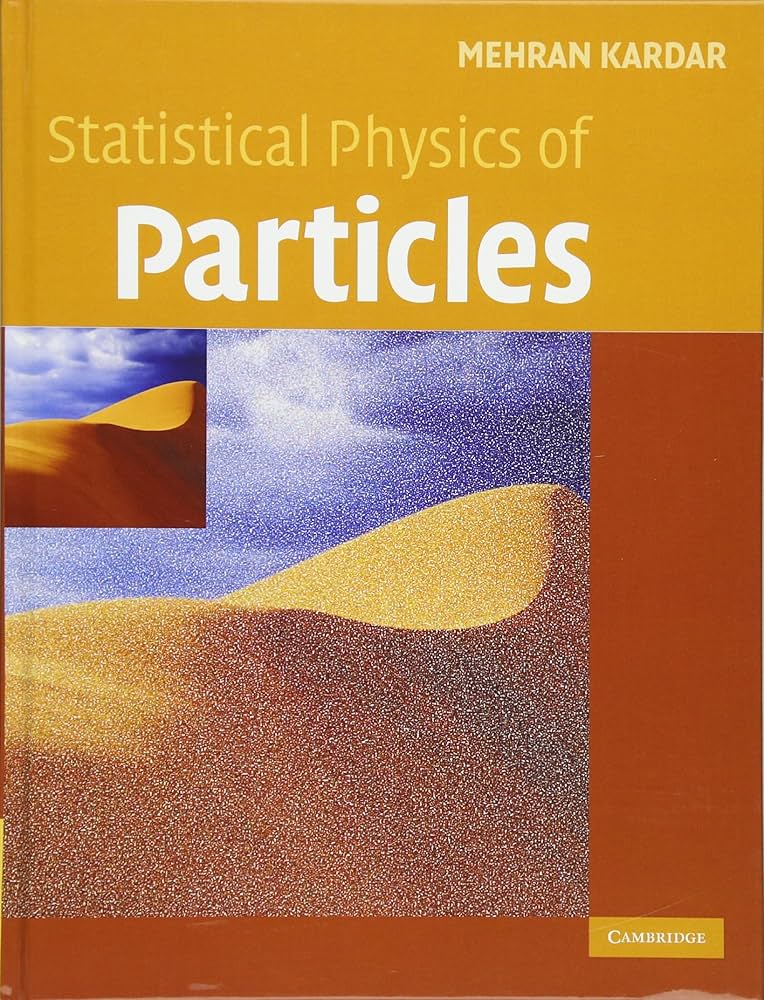
Statistical Physics of Particles
M. Kardar, Cambridge University Press
尊敬している物理学者、Mehran Kardar 先生による熱力学・統計力学の教科書です。 時系列としては、もう一冊の Statistical Physics of Fields を読んでとても感動し、 Kardar 先生のほかの本も読みたくなって購入した本です (MITの大学院講義がもとになっています)。
そのため、この本はつまみ読みしかしていません。ただ、つまみ読みしただけでも 色々な発見があり、大変面白い本です。熱力学や統計力学で、これ以上何か得られるものが あるのか?と思うかもしれませんが、第3章では BBGKY 階層や、名前だけはよく聞く \(H\) 定理が解説されています。こうした観点から眺めてみると、マクロな現象における 不可逆性の種のようなものが少し垣間見えた気がして、嬉しくなったりします。
A textbook on thermodynamics and statistical mechanics by Mehran Kardar, a physicist I deeply admire. Chronologically, I read his other book, Statistical Physics of Fields, was thoroughly impressed, and bought this book because I wanted to read more of his writing (it grew out of his MIT graduate course).
For that reason I have only skimmed it — but even skimming turns up one discovery after another. You might wonder what more there is to gain from thermodynamics and statistical mechanics, yet Chapter 3 covers the BBGKY hierarchy and the H-theorem (which everyone has heard of, if only by name). Viewed from this angle, I felt I caught a glimpse of the seeds of irreversibility in macroscopic phenomena — a quietly delightful moment.
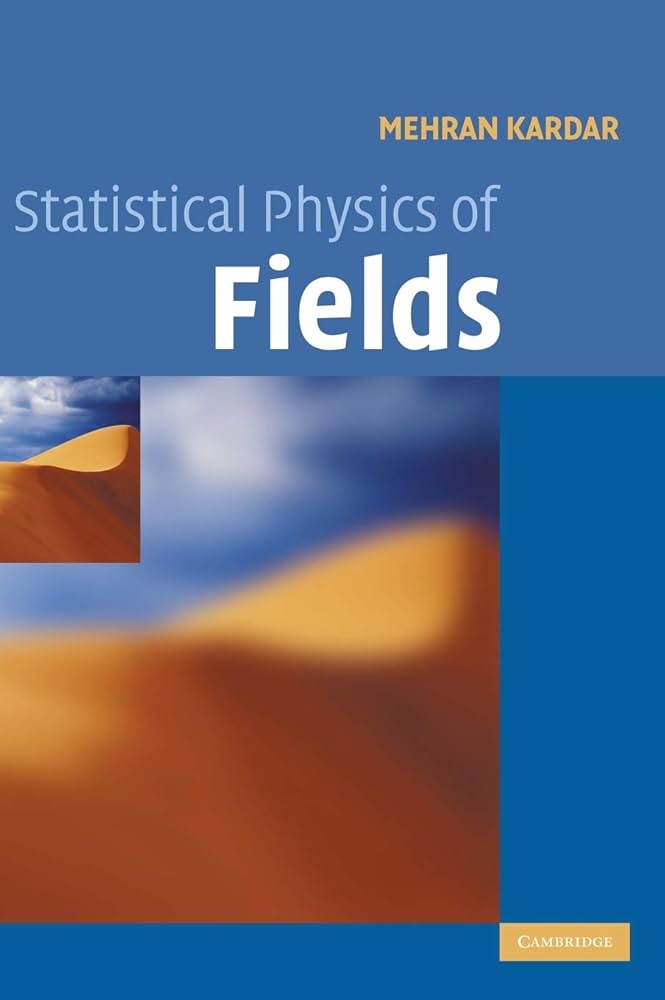
Statistical Physics of Fields
M. Kardar, Cambridge University Press
この本を読んで、Mehran Kardar 先生のファンになりました。 Landau-Ginzburg 理論という基礎から入るのですが、この基礎の段階ですら こんなに学ぶべきことがあるのかと圧倒された覚えがあります。
そこから Goldstone モード、感受率、揺らぎ、Ginzburg criterion へと進んでいきます。 Ginzburg criterion は平均場理論(鞍点法)の限界を教えてくれるもので、 こうした理解のもとで「なぜ従来型超伝導は BCS 理論(=平均場理論)で説明できるのに、 銅酸化物高温超伝導では平均場理論が破綻するのか」といったことを考えるのは とても大事だと改めて実感しました。「電子相関が弱ければ平均場でよく、 強ければ平均場を超える必要がある」という、それっぽいけれど正確とは言えない 表面的な理解を超えた先に見える物理的な世界観があること、そして、 現象論的な Landau-Ginzburg 理論でその本質が垣間見えることに感動しました。
さらにスケーリング仮説、繰り込み群へと進んでいきますが、この本のおかげで 繰り込み群が大好きになりました。長さスケールが消えた世界で繰り広げられる臨界現象、 そのユニバーサリティクラス、さらにそれを特徴づける臨界指数の間に成り立つ関係式が 自然に導かれていく様子は感動的です。
そして何と言っても本書の見どころは、非平衡統計力学の真骨頂である KPZ 理論が Kardar 先生自身の言葉で書かれていることです。§9.5 Non-equilibrium dynamics of open systems と §9.6 Dynamics of a growing surface は感動的です。 MIT に行かなくても Kardar 先生の素晴らしい物理観を分けていただける—— 感謝しかありません。
This is the book that made me a fan of Mehran Kardar. It starts from the basics with Landau-Ginzburg theory, and I remember being overwhelmed that even at this foundational stage there was so much to learn.
From there it proceeds to Goldstone modes, susceptibilities, fluctuations, and the Ginzburg criterion. The Ginzburg criterion tells you the limits of mean-field theory (the saddle-point method), and with that understanding it becomes deeply worthwhile to ask why conventional superconductivity is captured by BCS theory — a mean-field theory — while mean-field theory breaks down for the cuprate high-temperature superconductors. What moved me is that there is a physical worldview visible beyond the plausible-sounding but not quite accurate surface-level story that "weak correlations allow mean field, strong correlations require going beyond it" — and that the phenomenological Landau-Ginzburg theory already lets you glimpse its essence.
The book then moves on to the scaling hypothesis and the renormalization group — and it is thanks to this book that I came to love the RG. It is moving to watch critical phenomena unfold in a world without length scales, and to see universality classes and the relations among the critical exponents that characterize them emerge so naturally.
Above all, the highlight of this book is that KPZ theory — a crowning achievement of nonequilibrium statistical mechanics — is presented in Kardar's own words. Sections 9.5 (Non-equilibrium dynamics of open systems) and 9.6 (Dynamics of a growing surface) are breathtaking. To receive a share of Kardar's magnificent view of physics without ever setting foot in MIT — I have nothing but gratitude.
趣味(物理以外)For Fun (Non-Physics)

医者が教えるサウナの教科書医者が教えるサウナの教科書 (A Doctor's Guide to Sauna)
加藤容崇, Y. Kato, ダイヤモンド社
研究が忙しくて最近は行けていないのですが、サウナでいわゆる「ととのう」のが好きです。 (医学的に)正しい「ととのい方」があるということで、 この本を片手にサウナに通っていた時期がありました。
Research has kept me too busy to go lately, but I love the sauna experience the Japanese call totonou — that perfectly reset feeling. It turns out there is a (medically) correct way to achieve it, and there was a period when I frequented saunas with this book in hand.
ノートNotes
ブログ、物理ノート、数値計算のシミュレーション/解説など、書き物・作り物を置いていく場所です。 A place for blog posts, physics notes, numerical simulations and explanations, and other writings and creations.
ブログBlog
研究や日々の暮らしの中で、そのときどきに考えたことを書き残しています。誰かに何かを伝えるためというよりは、いつか自分で読み返したときに、当時の空気や気持ちを思い出すための日記です。その時点での未整理な考えや、今とは異なる感じ方も含めて、できるだけそのまま残しています。 These are records of whatever I happened to be thinking about, in research and in everyday life. They are less an attempt to tell anyone anything than a diary for my future self — a way to recall the air and mood of the moment when I reread them someday. I leave them largely as written, unpolished thoughts and feelings that may differ from how I see things now included.
-
2026年7月22日Jul 22, 2026初心忘るべからずNever Forget the Beginner's Spirit
-
2026年6月30日Jun 30, 2026帰仙Back in Sendai
-
2026年3月28日Mar 28, 2026失敗の地図A Map of Failures
-
2026年1月1日Jan 1, 2026去年の振り返りと新年の抱負Looking Back on 2025, Resolutions for 2026
-
2025年10月10日Oct 10, 2025留学準備開始Getting Ready to Study Abroad
-
2025年4月16日Apr 16, 2025お花見――仙台で送る研究生活Hanami — Research Life in Sendai
-
2025年4月8日Apr 8, 2025あ、うまくいった! その2Oh — It Worked! Part 2
-
2025年3月23日Mar 23, 2025大変、困っている……Seriously Stuck...
-
2025年1月1日Jan 1, 2025去年の振り返りと新年の抱負Looking Back on 2024, Resolutions for 2025
-
2024年10月19日Oct 19, 2024あ、うまくいった!Oh — It Worked!
-
2024年10月1日Oct 1, 2024半年を振り返ってLooking Back on the First Six Months
物理ノートPhysics Notes
大学の学部生の頃から現在に至るまで、勉強の際に TeX で書きためてきたノートを、Web上で読みやすい形に整えながら、順次掲載していく予定です。主な目的は自分自身のノートの整理・管理であるため、多くのページは限定公開となる予定です。内容にご興味のある方は、メールなどでご連絡ください。 These are study notes I have been writing in TeX since my undergraduate years, gradually reworked here into a web-friendly form. As their main purpose is to organise and manage my own notes, most pages will remain access-restricted — if you are interested, please feel free to contact me by e-mail.
はじめての量子統計A First Course in Quantum Statistics →
量子統計の基礎をまとめたノートです。フェルミ粒子とボース粒子の統計性の違いが、物理量にどのように反映されるのかを理解できます。 A note on the basics of quantum statistics: how the differing statistics of fermions and bosons are reflected in physical quantities.
はじめての第一原理計算First Steps in First-Principles Calculations →
密度汎関数理論(DFT)のノートです。ホーヘンベルク–コーンの定理からコーン–シャム方程式、LDA・GGAまで理論の骨格を証明付きで組み立て、仕上げに \(\mathrm{Na}\)・\(\mathrm{Ca}\)・\(\mathrm{Cu}\)・\(\mathrm{Ni}\) のバンド構造を実際に計算します。 A note on density functional theory (DFT): from the Hohenberg–Kohn theorems through the Kohn–Sham equations to LDA and GGA, proofs included — finishing with actual band-structure calculations for \(\mathrm{Na}\), \(\mathrm{Ca}\), \(\mathrm{Cu}\) and \(\mathrm{Ni}\).
はじめてのトポロジカル物性A First Course in Topological Matter →
トポロジカル物性のノートです。ベリー位相から出発して、チャーン数と量子ホール効果、トポロジカル絶縁体、ワイル半金属、マヨラナ粒子へと進み、最後は対称性による 10 クラス分類——「トポロジカル物質の周期表」——まで到達します。 A note on topological condensed matter: starting from the Berry phase, continuing through Chern numbers and the quantum Hall effect, topological insulators, Weyl semimetals and Majorana fermions, all the way to the tenfold way — the periodic table of topological matter.
はじめての経路積分A First Course in Path Integrals →
経路積分のノートです。1 粒子の量子力学から出発して、コヒーレント状態とグラスマン数、クーロンガスの遮蔽とプラズモン、超流動、BCS 超伝導、そしてスピン鎖のハルデン予想までを扱います。 A note on path integrals: from single-particle quantum mechanics through coherent states and Grassmann numbers, screening and plasmons in the Coulomb gas, superfluidity, BCS superconductivity, and the Haldane conjecture for spin chains.
はじめての強相関電子系A First Course in Strongly Correlated Electrons →
強相関電子系のノートです。Hubbard 模型をゼロから組み立て、超交換と \(t\)–\(J\) 模型、磁気秩序と量子臨界、近藤効果、動的平均場理論(DMFT)までを扱います。 A note on strongly correlated electrons: building the Hubbard model from scratch, then superexchange and the \(t\)–\(J\) model, magnetic order and quantum criticality, the Kondo effect, and dynamical mean-field theory (DMFT). (Work in progress.)
数値計算・シミュレーションNumerical Simulations
大学の学部生の頃から現在に至るまで、勉強や研究のかたわらで作ってきた数値計算コードを、Web上で誰でも気軽に試せる形にして公開しています。 These are numerical codes I have written alongside my studies and research since my undergraduate years, published here in a form that anyone can try right in the browser.
2次元正方格子のパーコレーションPercolation on the 2D Square Lattice →
占有確率 \(p\) をスライダーで動かして、クラスターが成長・融合し、 \(p_c \approx 0.5927\) で系を貫くクラスターが出現する様子を観察できます。 「乱数を撒くだけ」の単純な相転移なのに、そのユニバーサリティクラスは \(c = 0\) の非ユニタリーな共形場理論(CFT: Conformal Field Theory)で記述される、という深い模型です。 Drag the occupation probability \(p\) to watch clusters grow, merge, and — at \(p_c \approx 0.5927\) — span the lattice. A phase transition as simple as sprinkling random numbers, yet its universality class is described by a non-unitary conformal field theory (CFT) with \(c = 0\).
2次元 Ising 模型のモンテカルロシミュレーションMonte Carlo Simulation of the 2D Ising Model →
正方格子 Ising 模型の Metropolis シミュレーションです。 温度 \(T\) と結合定数 \(J\) をスライダーで動かして、強磁性秩序(\(J > 0\))や Néel 秩序(\(J < 0\))、そして \(T_c\) 付近の臨界揺らぎを観察してみてください。 A Metropolis simulation of the square-lattice Ising model. Drag the temperature \(T\) and coupling \(J\) to watch ferromagnetic order (\(J > 0\)), Néel order (\(J < 0\)), and critical fluctuations near \(T_c\).
2次元 XY 模型と Berezinskii–Kosterlitz–Thouless 転移The 2D XY Model and the Berezinskii–Kosterlitz–Thouless Transition →
スピンの角度を色相で表示し、渦・反渦をマーカーで可視化した XY 模型のモンテカルロです。 温度を動かして、\(T_{\mathrm{BKT}} \approx 0.89\,J\) を境に渦ペアが束縛から解離へ移り変わる BKT 転移——対称性の破れを伴わない、トポロジカル欠陥が主役の相転移——を観察できます。 A Monte Carlo simulation of the XY model with spin angles as hue and vortices/antivortices marked. Tune the temperature across \(T_{\mathrm{BKT}} \approx 0.89\,J\) and watch vortex pairs unbind — the BKT transition, driven by topological defects with no symmetry breaking.
LLG 方程式によるスピンダイナミクスとスカーミオンLLG Spin Dynamics & Skyrmions →
正方格子上の Heisenberg スピンを Landau–Lifshitz–Gilbert 方程式で実時間発展させます。 Dzyaloshinskii–Moriya 相互作用(DMI)と磁場のスライダーを動かすと磁気スカーミオンが核生成し、 トポロジカル電荷 \(Q\) がライブで整数値を刻みます。スカーミオンを1個植えて 安定性を確かめたり、磁場でつぶして \(Q\) が跳ぶ瞬間を見たりできます。 Heisenberg spins on the square lattice evolved in real time by the Landau–Lifshitz–Gilbert equation. Drag the Dzyaloshinskii–Moriya interaction (DMI) and field sliders to nucleate magnetic skyrmions, with the topological charge \(Q\) ticking through integers live — seed a single skyrmion, test its stability, or crush it with the field and watch \(Q\) jump.
界面成長:ランダム堆積 vs KPZSurface Growth: Random Deposition vs KPZ →
各列が独立なランダムウォークとして荒れていくランダム堆積(\(\beta = \dfrac{1}{2}\))と、 横方向の相関が育つ KPZ クラスの RSOS 模型(\(\beta = \dfrac{1}{3}\))を並べて成長させ、 界面幅 \(W(t)\) の log-log プロットでスケーリングの違いをライブで観察できます。 Random deposition — each column an independent random walk (\(\beta = \dfrac{1}{2}\)) — grows side by side with the RSOS model in the KPZ class (\(\beta = \dfrac{1}{3}\)), while a live log-log plot of the width \(W(t)\) reveals the different scaling.
MPS/TEBD による量子スピン鎖の実時間ダイナミクスQuantum Spin-Chain Dynamics with MPS/TEBD →
行列積状態(MPS)を TEBD(Time-Evolving Block Decimation)で時間発展させるテンソルネットワーク計算です。 横磁場 Ising・XXZ 鎖のクエンチで光円錐の広がりを見ながら、 エンタングルメントエントロピーが \(\ln \chi\) の壁に迫っていく様子—— 「なぜ量子ダイナミクスは難しいのか」——を体感できます (実装は厳密対角化・TeNPy と照合済み)。 A tensor-network computation — an MPS evolved by TEBD (time-evolving block decimation). Watch light cones spread in quenches of the transverse-field Ising and XXZ chains while the entanglement entropy climbs toward the \(\ln \chi\) wall: feel first-hand why quantum dynamics is hard (implementation validated against exact diagonalization and TeNPy).
MPS はどこまで正確か?— 横磁場 Ising 模型によるベンチマークHow Accurate Is an MPS? — Transverse-Field Ising Benchmark →
こちらはシミュレーションではなく静止画のベンチマークです。可解模型である 横磁場 Ising 鎖の基底状態を無限系密度行列繰り込み群(iDMRG)で計算し、厳密解と比較しました。 臨界点から離れると \(\chi = 8\) で誤差が倍精度の丸め誤差の床(\(10^{-14}\) 前後)に 達すること、臨界点では相関長が \(\xi \propto \chi^{\kappa}\)(\(\kappa \approx 2.034\))の 有限エンタングルメント・スケーリングに従うことが、\(\chi\) 依存性から見て取れます。 Not a simulation but a static benchmark: ground states of the exactly solvable transverse-field Ising chain computed with the infinite density matrix renormalization group (iDMRG) and compared with the exact solution. Away from criticality, \(\chi = 8\) already drives the error onto the double-precision round-off floor (~10−14); at the critical point the correlation length follows the finite-entanglement scaling \(\xi \propto \chi^{\kappa}\) with \(\kappa \approx 2.034\) — all visible in the \(\chi\)-dependence.
SSH 模型:トポロジカルエッジ状態と Wannier 中心The SSH Model: Topological Edge States and Wannier Centers →
トポロジカル絶縁体の最小模型である Su–Schrieffer–Heeger 模型です。 ホッピング比を動かすと、巻き付き数のジャンプ、 ゼロエネルギーエッジ状態の出現、Wannier 中心のセル中心からボンド中心への 移動が連動して起こる様子が見られます。カイラル対称性・バルク・エッジ対応・ Zak 位相まで含めた長めの解説付きです。 The Su–Schrieffer–Heeger model — the minimal topological insulator. Drag the hopping ratio and watch the winding number jump, zero-energy edge states appear, and the Wannier centers shift from cell centers to bond centers, all in lockstep. Comes with an extended discussion of chiral symmetry, bulk–boundary correspondence, and the Zak phase.
Kane–Mele 模型:量子スピンHall絶縁体The Kane–Mele Model: A Quantum Spin Hall Insulator →
グラフェンにスピン軌道相互作用を入れた \(\mathbb{Z}_2\) トポロジカル絶縁体の 原型模型です。ジグザグリボンのバンド構造を対角化し、 スピンで色分けされたヘリカルエッジ状態が現れて消える様子を 観察できます。スピン Chern 数と \(\mathbb{Z}_2\) 指数、相図、 時間反転対称性による保護(Kramers 対と後方散乱の禁止)まで じっくり解説しています。 The prototype \(\mathbb{Z}_2\) topological insulator: graphene with spin–orbit coupling. Zigzag-ribbon band structures are diagonalized on the fly, showing spin-resolved helical edge states appear and vanish as you cross the phase boundary. With spin Chern numbers, the \(\mathbb{Z}_2\) index, the phase diagram, and a careful discussion of time-reversal protection — Kramers pairs and forbidden backscattering.
Hofstadter バタフライ:磁場中の格子電子が描くフラクタルThe Hofstadter Butterfly: A Fractal Drawn by Lattice Electrons in a Magnetic Field →
磁場中の正方格子強束縛模型のスペクトルを、分母 \(q \le 41\) の すべての既約分数 \(\phi = p/q\) について対角化し、 自己相似フラクタル「バタフライ」を描きます。各ギャップを量子化 Hall 伝導度 (Chern 数)で色分けする表示付き。解説はパイエルス位相の導入から始めて、 Harper 方程式、有理数 vs 無理数とフラクタルの起源、TKNN と Diophantine 方程式、モアレ超格子での観測まで丁寧に書いています。 The spectrum of the square-lattice tight-binding model in a magnetic field, diagonalized for every reduced fraction \(\phi = p/q\) with \(q \le 41\), tracing the self-similar butterfly fractal — with a mode that colors each gap by its quantized Hall conductance (Chern number). The discussion starts from the Peierls phase and walks through the Harper equation, rational vs irrational flux and the origin of fractality, TKNN and the Diophantine equation, up to the moiré-superlattice observation.
ねじれ2層グラフェン:モアレ模様と平坦バンドTwisted Bilayer Graphene: Moiré Patterns and Flat Bands →
2枚のハニカム格子をねじれ角 \(\theta\) で重ね、実空間のモアレ模様と、 連続体模型(Bistritzer–MacDonald 型)で計算したモアレバンドが 連動して変形していく様子を観察できます。\(\theta\) を魔法角 \(\theta = 1.05^{\circ}\) まで下げると、 中央のバンドが数十 meV まで押し潰されて平坦バンドが現れます。 解説はうなりのアナロジーによるモアレ周期の導出から、連続体模型の考え方、 2つのエネルギースケールの競争と魔法角、平坦バンドが開いた 強相関・超伝導の物理まで。 Two honeycomb lattices stacked at a twist angle \(\theta\): watch the real-space moiré pattern and the continuum-model (Bistritzer–MacDonald) moiré bands deform in lockstep. Lower \(\theta\) to the magic angle \(\theta = 1.05^{\circ}\) and the central bands collapse into flat bands. The discussion runs from the beat-note derivation of the moiré period through the continuum model, the competition of two energy scales behind the magic angle, and the correlated/superconducting physics the flat bands unleashed.
Hubbard 模型と Mott 転移:動的平均場理論(DMFT)The Hubbard Model and the Mott Transition: Dynamical Mean-Field Theory (DMFT) →
半充填 Hubbard 模型(Bethe 格子)を動的平均場理論(DMFT)で解きます。 \(U\) を上げるとスペクトル関数が3ピーク構造を経て Mott ギャップを開き、上げ掃引と下げ掃引で答えが変わる共存領域(ヒステリシス)も 確認できます。解説は「電子は波か粒子か」——粒子数 \(n\) と位相 \(\theta\) の不確定性関係—— から始めて、Mott 転移の2つの描像、そして DMFT の考え方(動的な Weiss 場、 不純物問題への写像、無限次元極限での厳密性)まで。 The half-filled Hubbard model (Bethe lattice) is solved with dynamical mean-field theory (DMFT). Raising \(U\) takes the spectral function through the three-peak structure to the opening of the Mott gap, and sweeping \(U\) up versus down reveals the coexistence region (hysteresis). The discussion starts from “is the electron a wave or a particle?” — the \(n\)–\(\theta\) uncertainty relation — through the two pictures of the Mott transition, to the ideas of DMFT: a dynamical Weiss field, the impurity mapping, and exactness in infinite dimensions.
アクセス・連絡先Access & Contact
お問い合わせは以下のメールアドレスまで
Feel free to reach out via email
email(_at_ を @ に置き換えてください) (Please replace _at_ with @.)